

Absolutely not. Using a dado blade on a circular saw is extremely dangerous, illegal by tool safety standards, and will likely result in severe injury or tool failure. Circular saws are not built for the thick, stacked blades required for dado cuts. They lack the necessary arbor length, stability, and power distribution. Always choose a safer alternative like a router, a properly equipped table saw, or specific hand tools instead. Safety must always come first in your workshop.
As you start taking on more ambitious projects—like building custom shelving, bookcases, or sturdy cabinets—you quickly run into the need for dado cuts. These wide grooves, essential for solid, professional joinery, provide incredible strength by capturing the joining piece of wood. It’s totally natural to look at your trusty circular saw, the versatile workhorse of the home shop, and wonder: “Can I just swap the blade for a dado stack to make these grooves quickly?
While that idea is appealing for saving time and avoiding the purchase of an expensive specialized tool, mixing these tools is a recipe for disaster. Using a dado blade on a circular saw is not just discouraged—it is physically dangerous and strictly forbidden by tool manufacturers. You are right to ask this question before attempting it! Let’s dive deep into why this combination is unsafe, and most importantly, explore the practical, easy, and safe ways you can achieve perfect, strong dado joints today.
The Straight Answer: Why a Dado Blade and Circular Saw Are a Dangerous Mix
The short, clear answer is that a circular saw simply is not designed to handle the mechanical stresses of a dado stack. Every tool has specific engineering limits set by its manufacturer. Pushing a tool beyond those limits creates a hazardous environment, not just for the equipment but for you.
Here are the four critical reasons why this tool combination must never be attempted:
1. Insufficient Arbor Length and Thread Engagement
The arbor is the shaft that holds the blade in place. A standard circular saw arbor is designed to accommodate a single, thin blade—usually 1/8 inch or less, plus the washer and nut. A typical stacked dado set, however, can measure anywhere from 1/4 inch up to 13/16 inch thick.
If you force a thick dado stack onto a short circular saw arbor, you will only get minimal thread engagement with the arbor nut. This means the nut holding the entire blade assembly will not be screwed on far enough to be secure. The blade assembly will be unstable, prone to slipping, and highly likely to fly apart under load, turning your tool into a deadly projectile.
2. Severe Stress on the Motor and Bearings
Circular saw motors are engineered to cut a narrow kerf (the width of a single blade). A dado stack attempts to remove a huge amount of material—sometimes 8 to 10 times the amount of a standard blade—in a single pass. This extreme load instantly overstresses the motor, causing it to overheat and potentially burn out. More critically, the side load and vibration severely damage the tool’s internal bearings and gearbox, leading to catastrophic failure.
3. Lack of Proper Blade Guarding
A circular saw’s standard retractable guard is designed to fit snugly around a thin, standard blade. When you install a much thicker dado stack, the guard no longer fits properly or operates as intended. This leaves the majority of the sharp, spinning teeth exposed. Even if the blade stays attached, the lack of adequate guarding makes kickback and accidental contact highly probable.
4. No Adequate Workpiece Support
The most dangerous risk is kickback. When cutting a dado, the blade needs to be supported both above and below the workpiece for stability. A circular saw is a handheld tool designed to cut straight lines on a flat surface. It has no throat plate or table to support the wood immediately surrounding the cut. If the spinning dado stack grabs the wood—which is likely due to the massive material removal rate—the saw will violently kick back toward you. This is one of the most common causes of serious woodworking injuries.

Understanding Dado Blades: Not Just a Single Blade
To fully appreciate the mechanical difference, it helps to know exactly what a dado blade system is. It is not just one thick piece of metal; it is a precisely engineered assembly.
A typical high-quality dado blade set (often called a “dado stack”) consists of:
- Two Outer Blades: These are specialized blades, often with flat-top teeth (FTG), that define the clean outer shoulders of the dado cut.
- Chippers: These are thicker, two- or four-winged cutters that stack in the middle, between the outer blades. Their job is to quickly hog out the waste wood.
- Shims and Spacers: Extremely thin metal or plastic rings used to fine-tune the exact width of the final dado cut, ensuring perfect fit for the joining material.
This entire assembly is designed to be tightly secured by a long arbor nut on a specialized machine—specifically a table saw or a radial arm saw—that has the robust power and structure required. Trying to use this bulky, multi-part system on a lightweight, handheld circular saw is simply asking for trouble.
Mechanical Differences: Table Saw vs. Circular Saw
The safest and most common way to use a dado stack is on a table saw. Reviewing the basic design differences illustrates why one tool is safe for this task and the other is not.
| Feature | Circular Saw (Handheld) | Table Saw (For Dado Stacks) |
|---|---|---|
| Arbor Length | Short (Designed for 1/8″ blade max) | Long (Designed for stacked blades up to 13/16″) |
| Power Transfer | Direct drive, designed for light load | Belt or heavy-duty direct drive, designed for sustained high torque and wide cuts |
| Workpiece Support | None (handheld) | Fixed table and throat plate; wood is fully supported |
| Blade Stabilization | Minimal (rely on user control) | Massive casting, heavy bearings, and secure fence/miter gauge system |
| Safety Guarding | Retractable guard (only fits thin blade) | Fixed internal guarding, specialized dado inserts to close the throat gap |
As you can see, the table saw provides a fixed, stable platform that keeps the wood steady and supports the high torque required for wide material removal. The circular saw offers none of these critical safety features.
Safe Alternatives: How to Cut Dadoes Without a Dado Stack
Since we have established that the circular saw is off-limits for dado stacks, what are your reliable and safe options? Thankfully, there are three excellent, beginner-friendly methods to achieve strong, clean dado joints without risking a finger or destroying your saw.
These methods prioritize control, safety, and a clean finish.
Method 1: The Router and Straight Edge Guide (The Safest Approach)
For most DIYers, a router is the absolute best tool for cutting high-quality dadoes. A router excels at clearing material across a wide path, and when paired with a simple straight-edge jig, it provides outstanding control and accuracy.
Tools and Materials Needed:
- Router (Plunge or Fixed Base)
- Straight Router Bit (match the desired dado width)
- Clamps
- Straight Edge or Factory-Made Guide Rail System
- Measuring Tape and Pencil
Step-by-Step Instructions for Router Dadoes:
- Measure and Mark: Precisely mark the width and location of your dado on the workpiece. Use a square to extend these lines across the board.
- Determine the Offset: The router bit is always offset from the edge of the router base. Before cutting, measure the distance from the side of the router bit to the edge of your router baseplate. This is your critical “offset measurement.”
- Position the Guide: Use the offset measurement to position your straight edge. If your dado needs to be 6 inches from the edge of the board, you place the guide rail 6 inches PLUS the offset measurement from the edge. Clamp the guide down firmly.
- Set the Depth: Set the plunge depth or fixed depth stop on your router to the desired depth of the dado (usually about one-third the thickness of the material).
- Make Multiple Passes: Do not try to cut the full depth in one go. To prevent burning the wood and stressing the router, cut the dado in two or three shallow passes. The first pass should remove about half the material, and the final pass should bring it to the final depth. This results in a cleaner groove and less stress on the tool.
- Test Fit: After routing, unclamp the board and test the fit with the mating piece of wood. Adjust depth or width shims if necessary.
Meraj’s Mentor Tip: Always make a simple practice cut on scrap material first. This lets you check the fit and ensure your offset calculation is perfect before you cut into your actual project piece.
Method 2: Multiple Passes with a Circular Saw (The Safe Workaround)
If you absolutely do not have a router and your budget is tight, you can carefully use your circular saw to simulate a dado cut. However, this method requires maximum concentration, precision, and relies heavily on a solid jig or guide system.
Note: While this method uses the circular saw, it still uses a standard, single blade. It is safe because you are only removing a small amount of material with each pass, keeping the arbor thin and the load manageable.
Tools and Materials Needed:
- Circular Saw (Standard Single Blade Installed)
- Custom-built Guide/Jig (or high-quality track saw track)
- Clamps
- Chisel or Router Plane (for clean up)
Step-by-Step Instructions for Multiple-Pass Dadoes:
- Build/Set Up the Guide: This step is non-negotiable. You must use a straight edge or jig that is clamped securely across the workpiece. This guide ensures all passes are perfectly straight.
- Mark the Shoulders: Clearly mark the two outer lines (shoulders) of your desired dado width.
- Set the Depth: Set the circular saw blade depth to the final desired depth of the dado (e.g., 1/4 inch deep).
- Cut the First Shoulder: Clamp your guide fence so that the saw blade makes a perfect cut exactly on the waste side of your first shoulder line. Make the cut.
- Cut the Second Shoulder: Move the guide fence and clamp it again so the blade cuts exactly on the waste side of the second shoulder line. Make the cut.
- Clear the Waste: Now you have defined the two edges of the dado. Move the guide fence slightly and begin making repeated, parallel cuts between the two shoulder lines. These cuts should be spaced about 1/8 to 1/4 inch apart.
- Clean Up: Once the material has been scored, the remaining wood slivers between the passes must be removed. Use a sharp chisel, held bevel-down, or a small router plane to carefully pare and scrape the bottom of the dado flat and smooth.
This method is slow and labor-intensive, but it achieves a functional and structurally sound joint using only standard tools. For more information on safe circular saw operation, check reputable resources like the U.S. Consumer Product Safety Commission (CPSC) guidelines on power tool usage.
Method 3: Hand Tools (The Traditional Approach)
If you are working with small pieces, or simply enjoy the quiet process of hand tools, a sharp chisel and a saw are all you need. This technique requires patience but results in exceptional accuracy and a very clean finish.
Tools Needed:
- Backsaw or Japanese Pull Saw
- Razor-sharp Chisel (width matching the dado is ideal)
- Clamps and a Bench Vise
- Mallet
Step-by-Step Instructions:
- Mark Clearly: Use a marking knife and square to scribe the two shoulder lines and the depth lines on the edge of the board. The marking knife creates a tiny groove that prevents the saw and chisel from wandering.
- Saw the Shoulders: Carefully use your backsaw to cut down to the depth line on both of the shoulder lines. Always cut on the waste side of the line.
- Remove the Waste: Use your sharp chisel and mallet. Starting near the center of the waste area, place the bevel of the chisel facing down. Tap the chisel lightly, moving backward from the edge.
- Refine the Base: Once the bulk of the material is removed, use the chisel, held flat and perpendicular to the cut, to scrape the bottom flat and smooth. Take very light passes for the cleanest result.
In-Depth Comparison: Choosing Your Best Dado Method
Choosing the right method depends on your budget, how many dadoes you need to cut, and the required finish quality. This table compares the three safest alternatives:
| Method | Speed | Precision/Finish | Required Investment | Best For |
|---|---|---|---|---|
| Router & Jig | Fast and repeatable | Excellent (machine-perfect, smooth floor) | Medium (Cost of a decent router and bit set) | Cabinetry, batch production, wide dadoes. |
| Multiple-Pass Circular Saw | Slow and labor-intensive | Good (requires careful chisel cleanup) | Low (only requires existing saw and lumber for jig) | Single projects, budget constraints, large panels. |
| Hand Tools (Chisel & Saw) | Very Slow | Exceptional (traditional quality, perfect fit) | Low to Medium (must have very sharp tools) | Fine furniture, small pieces, traditional woodworking. |
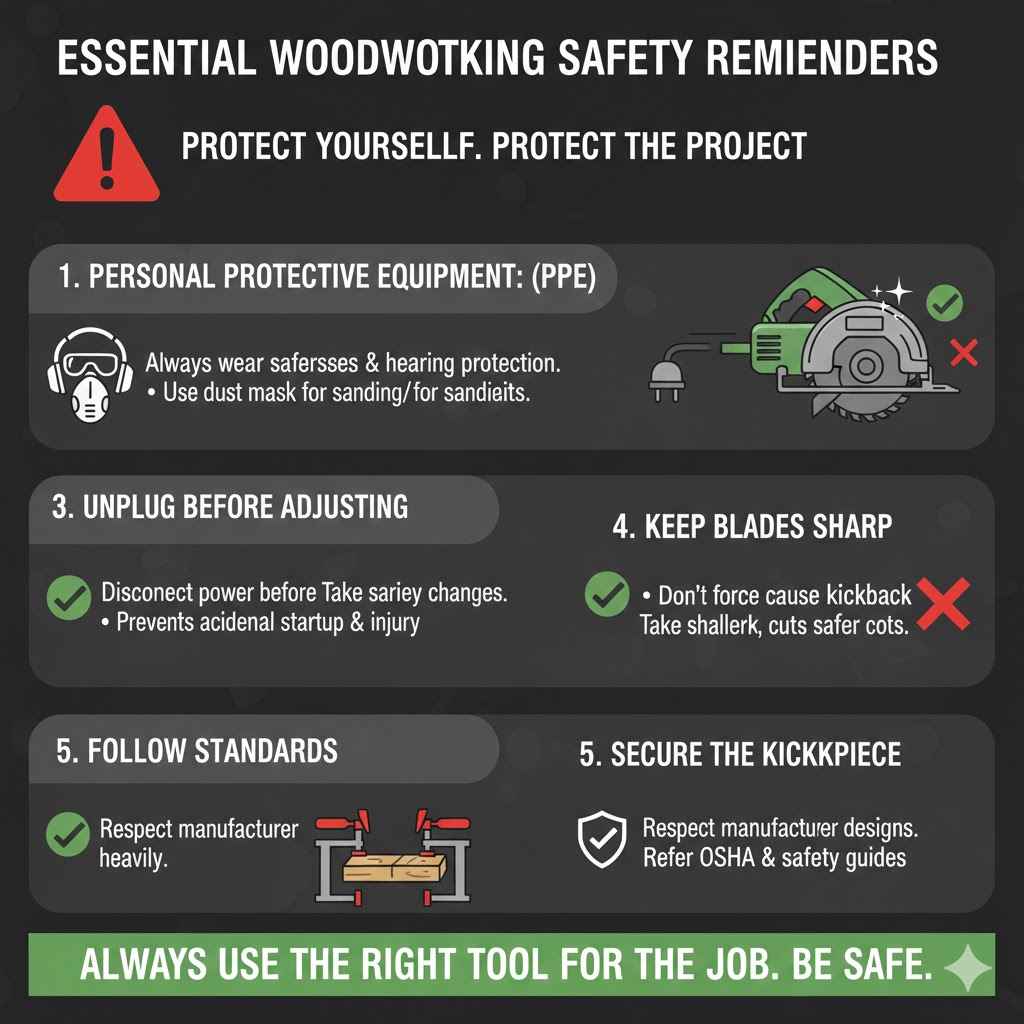
Essential Woodworking Safety Reminders
As your trusted woodworking mentor, I must always emphasize safety. Understanding why certain tool combinations are unsafe is the first step toward becoming a truly confident and capable woodworker.
Always incorporate these fundamental safety principles into every session:
- Personal Protective Equipment (PPE): Always wear safety glasses or goggles. Hearing protection is vital when running loud power tools like a circular saw or router. Consider a dust mask, especially when routing or sanding.
- Unplug Before Adjusting: Whether you are swapping a standard blade or changing a router bit, always unplug the tool from the wall power outlet first. This prevents accidental startup, which causes serious injury.
- Keep Your Blades Sharp: Dull blades require more force, generate more heat, and are a leading cause of binding and kickback. Sharp tools are safer tools.
- Know Your Tool’s Limits: Never force a cut. If your tool is struggling, back off, check your setup, and take shallower passes. A tool that is laboring is a tool that is about to fail or kick back.
- Secure the Workpiece: Use clamps heavily. The wood should never move while the blade or bit is engaging it.
The importance of tool safety standards cannot be overstated. Manufacturers design tools for specific tasks and conditions. Trying to repurpose heavy-duty accessories like dado stacks onto handheld tools designed for light work fundamentally voids those safety assurances. Following best practices, like those outlined by organizations like the Occupational Safety and Health Administration (OSHA), ensures you maintain a safe environment. You can learn more about general workshop safety protocols through official safety and health guides.
Frequently Asked Questions About Dadoes and Circular Saws
Can a circular saw handle a wobble dado blade?
No. A wobble dado blade (an adjustable single blade designed to wobble slightly to widen the cut) puts immense, cyclical stress on the saw’s arbor, bearings, and motor. While it is thinner than a stacked set, the heavy vibration and uneven load make it just as dangerous to use on a handheld circular saw as a traditional stack. Only use wobble dado blades on machines specifically designed to handle them, like table saws.
What is the maximum width of a dado I should cut?
The width of the dado should perfectly match the thickness of the material being inserted into it. Structurally, the depth of the dado should generally be no more than one-third the thickness of the material being cut. For example, on a 3/4 inch board, the dado should be about 1/4 inch deep.
Is it possible to convert a circular saw to accept a dado stack?
Theoretically, you could try to modify the arbor, but this is incredibly ill-advised. Modifying the structural integrity and design of a power tool voids all safety certifications and warranties. Since the circular saw motor, housing, and bearings are not designed to handle the torque or mass of a dado stack, modification will simply result in catastrophic tool failure and significant risk of injury.
How do professional cabinet makers usually cut dadoes?
Professionals predominantly use two methods:
- A table saw equipped with a high-quality stacked dado set, especially for production runs or repeatable cuts.
- A powerful plunge router, often paired with an engineered track system, for cutting dadoes on large sheet goods (plywood) where moving the entire sheet over a table saw is impractical or unsafe.
Is it ever okay to use two standard circular saw blades together to create a dado?
No, this is highly dangerous for the same reason a dado stack is dangerous. Adding a second thin blade, even if slightly spaced by washers, still increases the total thickness on the arbor past its design limit. The nut will not securely fasten the blades, leading to imbalance, extreme vibration, and the high risk of the blades flying off.
What is the difference between a dado and a groove?
In woodworking terminology, they are essentially the same cut (a slot cut across the grain). However, a dado is typically cut across the grain of the wood, while a groove is cut parallel with the grain. Structurally, they are both methods of creating a slot for strong joinery.
Choose the Safe Path to Success
It is easy to see the circular saw as the answer to every cutting problem in the shop. But good woodworking is about using the right tool for the job. Asking the question, “Can I use a dado blade on a circular saw?” shows that you are thinking ahead about efficiency, but answering “No, it’s dangerous,” is the mark of a wise craftsman who prioritizes safety.
For your dado joints, embrace the router and jig method. It is incredibly versatile, safe, and produces consistently beautiful, strong results that will make your bookcases and cabinetry last for decades. Skip the shortcuts that put your safety at risk. By choosing one of the safe alternatives we discussed, you will build better projects, increase your confidence, and ensure you keep all ten fingers ready for your next project.