
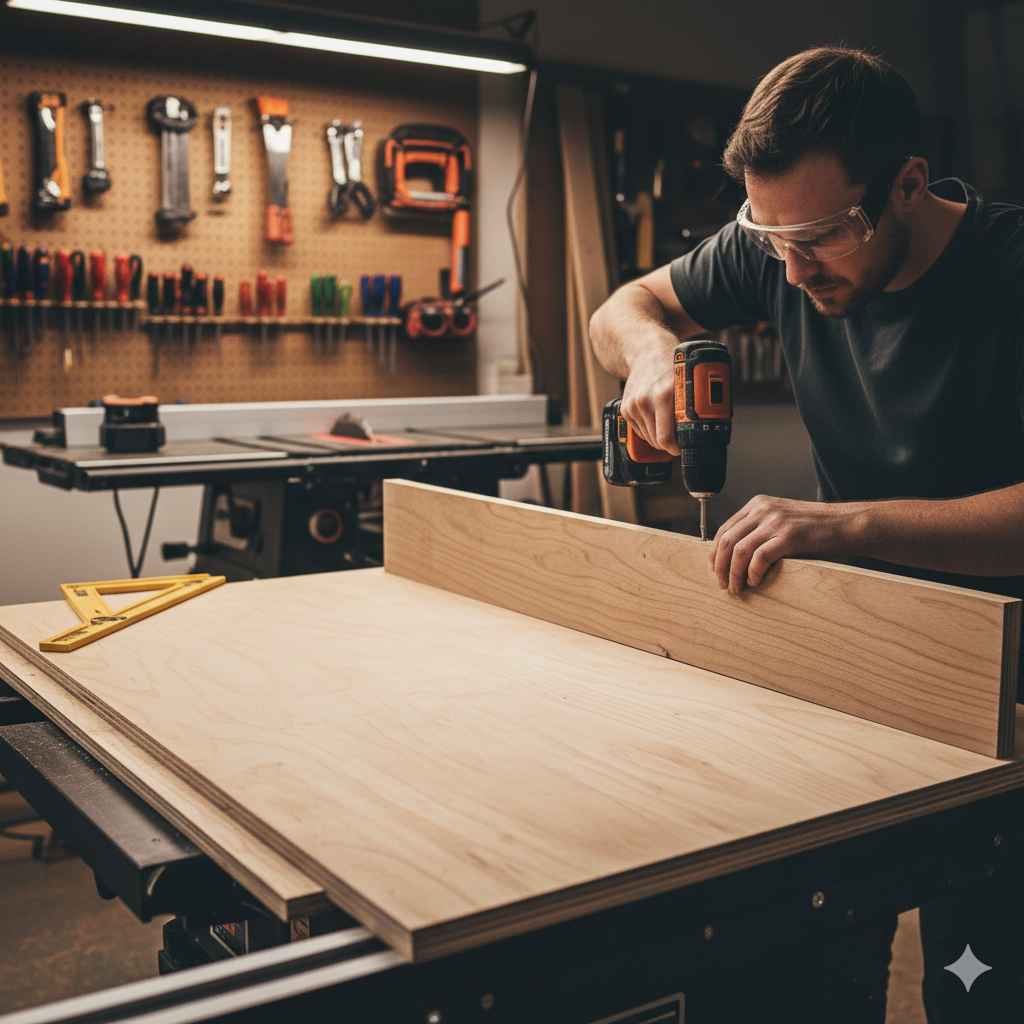
Making a crosscut sled for your table saw involves cutting a flat plywood base, attaching hardwood runners that fit your saw’s miter slots, and mounting a front and back fence. The key is perfectly squaring the main fence to the blade to guarantee precise, repeatable 90-degree cuts for all your woodworking projects.
Does your table saw miter gauge feel wobbly? Do your crosscuts end up just a little bit off? It’s a common problem that frustrates even seasoned woodworkers. You measure twice, cut once, and still find a small gap in your project joints. This simple inaccuracy can ruin an entire piece. But there is a solution that will change your woodworking forever. It’s a shop-made tool that gives you perfect, safe, and repeatable cuts every single time. In this guide, I’ll walk you through building your own crosscut sled, step by simple step.
Why Every Woodworker Needs a Crosscut Sled
Before we pick up a single tool, let’s talk about why a crosscut sled is not just a “nice-to-have” jig, but an essential part of any workshop. The standard miter gauge that comes with most table saws is often flimsy and lacks the support needed for larger pieces of wood. A crosscut sled solves these problems and offers several huge advantages.
The Top 4 Benefits of a Crosscut Sled
- Unbeatable Accuracy: A well-made sled is dialed in to be perfectly square to your saw blade. This means every cut you make will be a true 90 degrees. This level of precision is nearly impossible to achieve consistently with a standard miter gauge.
- Enhanced Safety: With a crosscut sled, your hands are kept far away from the spinning blade. The sled base supports the wood, and you push the entire sled, not the workpiece itself. This stable setup dramatically reduces the risk of kickback.
- Superior Support: Trying to balance a wide board or a long plank on a tiny miter gauge is scary and unstable. A sled provides a large, flat surface that fully supports your workpiece, preventing it from tipping or shifting during the cut.
- Perfect Repeatability: Once your sled is built, you can easily add stop blocks to make identical cuts over and over. This is a game-changer for projects that require multiple parts of the same length, like cabinet doors, picture frames, or drawers.
Think of a crosscut sled as upgrading your table saw from a basic tool into a precision crosscutting machine. It’s the single most impactful jig you can build for your shop.

Safety First: A Quick But Critical Reminder
Building and using a crosscut sled is safe, but a table saw is a powerful tool that demands respect. Always follow proper safety procedures. Your well-being is more important than any project.
- Unplug the Saw: Before making any adjustments, measurements, or installations near the blade, always unplug your table saw from the power source. No exceptions.
- Wear Your PPE: Safety glasses are mandatory to protect your eyes from dust and debris. A dust mask and hearing protection are also highly recommended.
- Understand Your Saw: Be familiar with your table saw’s components, especially the riving knife or splitter. For the first cut through the sled, you will likely need to remove the blade guard, but you should always use a riving knife if your saw has one. Learn more about table saw safety from official sources like the Occupational Safety and Health Administration (OSHA).
- Keep Hands Clear: A crosscut sled naturally keeps your hands away from the blade. Maintain this safe distance. Never reach over the blade while it is spinning.
Tools and Materials You’ll Need
The best part about this project is that you can build it with common materials, most of which you might already have in your scrap pile. You don’t need fancy tools, just the basics.
Materials List
| Material | Recommended Size | Notes |
|---|---|---|
| Plywood (Base) | 1/2″ or 3/4″ thick, approx. 24″ x 30″ | Baltic Birch or high-quality cabinet-grade plywood is best because it’s flat and stable. MDF can also work but is heavier. |
| Hardwood (Runners) | Two strips, 3/4″ thick, approx. 24″ long | Maple, oak, or another stable hardwood is ideal. The width should match your saw’s miter slots perfectly. |
| Hardwood or Plywood (Fences) | Two pieces, approx. 3″ tall x 30″ long | Must be perfectly straight. Laminated layers of plywood or a stable hardwood work well. |
| Wood Glue | Any quality wood glue | Titebond II or III are excellent choices. |
| Screws | Various sizes | #8 screws of appropriate length for attaching runners and fences. Use flat-head screws for the runners. |
| Paste Wax | Optional, but recommended | Helps the sled glide smoothly in the miter slots. |
Tools List
- Table Saw
- Tape Measure
- Combination Square or Carpenter’s Square
- Drill and Drill Bits (including a countersink bit)
- Clamps
- Pencil
- Safety Glasses, Hearing Protection, Dust Mask
Step-by-Step Guide to Building Your Perfect Crosscut Sled
Ready to build? We’ll take this one step at a time. Don’t rush the process. Accuracy in the early steps will pay off with a sled that serves you well for years.
Step 1: Cut the Sled Base
The base is the foundation of your sled. It needs to be flat, square, and sized appropriately for your saw and the types of projects you do.
- Choose Your Size: A good starting size for a general-purpose sled is around 24 inches deep (front to back) and 30 inches wide (left to right). This is large enough for most projects without being too heavy or clumsy.
- Make the Cut: Using your table saw and its rip fence, cut your 1/2″ or 3/4″ plywood to your desired final dimensions. Check the corners with a square to ensure they are 90 degrees. This is your sled base. Set it aside.
Step 2: Mill the Runners
The runners guide your sled along the miter slots in your table saw top. They must fit perfectly—not too tight, not too loose. A snug, gliding fit with no side-to-side wiggle is the goal.
- Measure Your Miter Slots: Use a precise ruler or calipers to measure the width and depth of the miter slots on your table saw. They are typically 3/4″ wide and 3/8″ deep, but you must measure your specific saw.
- Select Hardwood: Choose a stable, straight-grained hardwood like maple or oak for your runners. Softwoods like pine can compress over time, leading to a sloppy fit.
- Rip the Runners: Set your table saw fence to the exact width of your miter slots. Make a test cut on a piece of scrap hardwood. Check the fit. You want it to slide in with very little effort but have no side-to-side play. Adjust your fence in tiny increments until the fit is perfect. Once you’re satisfied, rip two runner strips to the length of your sled base (e.g., 24 inches).
- Set the Thickness: The runners should be slightly shallower than the depth of your miter slots so they don’t drag on the bottom. An easy trick is to place the runners in the slots and lay a few coins (like pennies) on top of them. The runners should sit just below the table surface, allowing the sled base to ride on the table, not the runners. If they are too thick, carefully shave a small amount off at the table saw or with a hand plane.
Step 3: Attach the Runners to the Base
This step ensures your sled will travel perfectly parallel to the saw blade. We’ll use glue and screws for a rock-solid connection.
- Position the Runners: Place the two finished runners into the miter slots on your table saw. Place the coins on top of them to raise them slightly.
- Apply Glue: Run a bead of wood glue along the top of each runner.
- Place the Base: Carefully lay your plywood sled base on top of the runners. Align it so it’s square to the front of your saw. Make sure you have enough overhang on each side of the miter slots.
- Add Weight and Let it Dry: Place some heavy objects (like paint cans, weights, or stacks of books) on top of the plywood base directly over the runners. This will press the base firmly onto the glued runners. Let the glue dry for at least an hour.
- Secure with Screws: After the glue has set, carefully slide the entire assembly off the table saw. Flip it over. Drill and countersink pilot holes through the runners and into the base every 4-6 inches. Drive in flat-head screws. The countersinking is crucial so the screw heads sit below the surface of the runners and don’t scratch your saw top.
- Test the Fit: Flip the sled back over and place it on your saw. It should glide smoothly back and forth without any binding or wiggling. Apply a little paste wax to the runners and the bottom of the sled for an even smoother action.
Step 4: Create and Attach the Fences
The fences are what make the sled work. The back fence provides stability and a place to push from, while the front fence is the reference surface that guarantees a square cut.
- Cut the Fence Pieces: From your hardwood or laminated plywood, cut two pieces to be your fences. A good height is around 3 inches. Make sure the edges are perfectly straight and parallel. The front fence should be slightly longer than the width of your sled base, and the back fence can be the same width as the base.
- Attach the Back Fence: The back fence (the one closer to you) is mainly for stability and doesn’t need to be perfectly square. Position it along the back edge of the sled base. Drill, countersink, and screw it in place from the bottom of the sled. You can also add glue for extra strength.
- Temporarily Attach the Front Fence: Position the front fence (the one farther from you) across the base. You only want to attach it with a single screw for now, near one end. This single screw will act as a pivot point, allowing you to adjust the fence for perfect squareness. Drive a screw from the bottom up into the fence.
Step 5: Squaring the Front Fence (The Most Important Step)
This is where the magic happens. A sled is only as good as its fence is square. Don’t rely on a carpenter’s square alone. We will use the highly accurate “5-Cut Method” to dial it in perfectly.
The 5-Cut Method uses the saw itself to magnify any error, making it easy to detect and correct. It sounds complex, but it’s a simple process. A detailed explanation can be found from many expert sources, including this guide from Woodworkers Guild of America.
How the 5-Cut Method Works:
- Make the First Cut Through the Sled: UNPLUG YOUR SAW. Raise the blade so it will cut about halfway through your front fence. Remove the riving knife and blade guard if necessary for this one operation. Plug the saw back in, turn it on, and carefully push the sled forward until the blade cuts through the base and the back fence. Then, push it all the way through to cut a kerf in the front fence as well. This cut establishes your sled’s zero-clearance line. Turn off and unplug the saw.
- Prepare a Test Board: Grab a large, stable piece of scrap plywood or MDF, about 12″ x 12″. Make sure it has one perfectly straight edge.
- Make Four Cuts: Place the straight edge of your test board against the sled’s front fence and make a cut, trimming off about an inch. Rotate the board 90 degrees counter-clockwise so the fresh-cut edge is now against the fence. Make another cut. Repeat this rotation and cutting process two more times for a total of four cuts. You are essentially cutting all four sides of the board.
- Make the Fifth and Final Cut: After the fourth cut, rotate the board one last time. This time, instead of cutting the full length, just cut off a thin strip (the “offcut”) from the end. This strip is what we will measure.
- Measure the Offcut: Take the thin offcut strip and measure its width at both ends with calipers. If the fence is perfectly square, the strip will be the exact same width at both ends. If it’s not, there will be a difference. This difference represents the total error magnified over four cuts.
Making the Adjustment
If there’s a difference in your measurements, you need to adjust the fence. Nudge the unsecured end of the fence slightly forward or backward, depending on the error. Tighten the pivot screw and add a second screw at the other end to temporarily lock it. Repeat the 5-cut test with a new piece of scrap. Continue this process until the offcut strip measures the same width on both ends. You’re aiming for an error of less than a thousandth of an inch.
Once you achieve perfection, secure the front fence permanently with several more screws from the bottom of the sled. Now you have a perfectly calibrated cutting machine!
Step 6: Add the Finishing Touches
Your sled is functional, but a few final details will make it safer and more user-friendly.
- Install a Blade Guard Block: Glue and screw a thick block of wood onto the back fence directly over where the blade comes through. This creates a box that covers the blade as it exits the cut, preventing accidental contact. This is a critical safety feature.
- Add a Stop Block (Optional): You can create a simple stop block that clamps to your front fence for making repeatable cuts. For a more advanced version, you can rout a channel in the fence and install a T-track and a flip-stop.
- Apply a Finish: A few coats of paste wax or shellac on the bottom of the sled will protect it from moisture and help it glide even more smoothly.
Tips for a Perfect Build
Here are a few extra tips to keep in mind as you build your crosscut sled:
- Start with Flat Materials: If your plywood base is warped or your fence material is bowed, you will never get an accurate sled. Check all your materials with a straightedge before you begin.
- Take Your Time on the Runners: The fit of the runners is foundational. If they are too loose, the sled will be inaccurate. If they are too tight, it will be frustrating to use. Aim for a fit that feels like a piston—smooth and without slop.
- Don’t Skip the 5-Cut Method: Trust the process. A large framing square might get you close, but the 5-Cut Method will get you to perfect. It is the gold standard for a reason.
- Embrace the “Good Enough”: While we aim for perfection in squaring the fence, don’t get stuck chasing an impossible tolerance. An error of 0.001″ over the length of the test strip is more than accurate enough for any woodworking project.

Frequently Asked Questions (FAQ)
What is the best material for a crosscut sled?
High-quality, void-free plywood like Baltic Birch is the best choice for the base because it is extremely flat and stable. For the runners and fences, a stable hardwood like hard maple or quarter-sawn oak is ideal because it resists warping.
Can I use MDF for my sled base?
Yes, you can use MDF. It is very flat and inexpensive. However, it is much heavier than plywood and is more susceptible to damage from moisture. If you use MDF, be sure to seal it well with shellac or paint.
How thick should the sled base be?
A 1/2″ thick base is a great choice for most sleds. It keeps the weight down while still being rigid enough. If you plan to build a very large sled for heavy-duty work, stepping up to 3/4″ plywood can provide extra stability.
How do I know if my sled is accurate?
The 5-Cut Method described above is the most reliable way to test and prove the accuracy of your sled. Once calibrated, you can also test it by cutting two pieces of wood, flipping one over, and joining the cut edges. If there is no visible gap, your sled is perfectly square.
Why does a crosscut sled need a back fence?
The back fence serves two main purposes. First, it adds significant rigidity to the sled, helping to keep the base flat. Second, it connects the two sides of the sled behind the blade, preventing the sled from flexing or falling apart after the blade cuts through the base.
What if my runners are too tight or too loose?
If they are too tight, you can sand them down slightly or run them over a jointer to take off a tiny amount of material. Applying paste wax can also help. If they are too loose, it is best to start over and make new runners. A sloppy fit cannot be fixed and will result in an inaccurate sled.
Can I add a T-track to my sled fence?
Absolutely! Adding a T-track to the top of your front fence is an excellent upgrade. It allows you to use commercially available flip-stops and hold-down clamps, making your sled even more versatile and easy to use.
Conclusion: A Workshop Game-Changer
Congratulations! You now have all the knowledge you need to build a perfect crosscut sled for your table saw. This simple jig, built from a few scraps of wood, will fundamentally improve the quality of your work. Your projects will come together with tighter joints, cleaner lines, and a level of precision you may have thought was only possible with expensive machinery.
Building your own tools is one of the most rewarding aspects of woodworking. Take your time with this project, enjoy the process, and get ready to experience a new level of accuracy and safety in your shop. Your crosscut sled will quickly become one of the most-used and most-loved tools you own.