REFERENCE_BY_POINTER BSOD fix in Windows 11 fast guide
For REFERENCE_BY_POINTER BSODs on Windows 11, start with dump evidence: if recent minidumps point to one driver, fix that first. If the dumps do not point to a clear culprit, test RAM next and then check the disk. This stop code has a value of 0x00000018. It indicates that the reference count of an object is illegal for the current state of the object.
What REFERENCE_BY_POINTER means on Windows 11
REFERENCE_BY_POINTER is bug check 0x00000018. It is caused by an inconsistency in an object’s reference count. Typically, that happens when a driver decreases the reference count too many times, when the count reaches zero while handles are still open, or when the count drops below zero. The same stop code can also appear on Windows 10 and Windows 11.
When this appears once after a new driver or app install, treat it as a clue. When it repeats across different boots, the crash is usually tied to the same underlying reference-count problem.
Likely causes, ranked from most common to least obvious
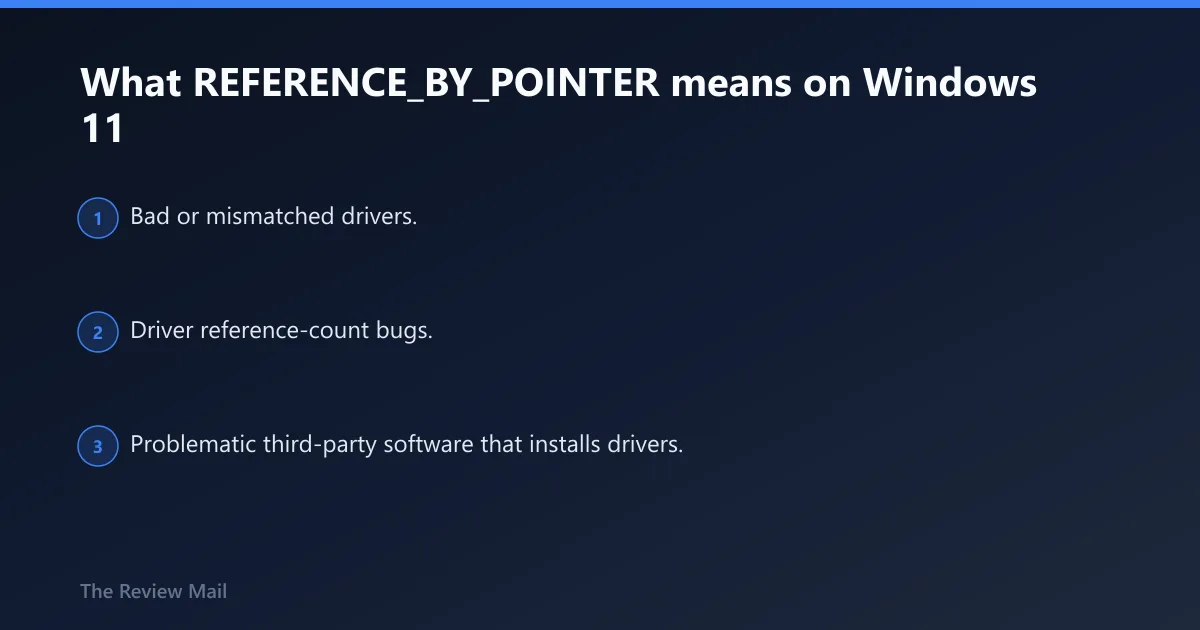
- Bad or mismatched drivers. This is the first thing to check, especially after a recent update.
- Driver reference-count bugs. The driver may be dereferencing an object too many times or in the wrong order.
- Problematic third-party software that installs drivers. Storage, virtual drive, security, or VPN software can install filter drivers that affect object handling.
How do I tell whether this is a driver, RAM, or storage problem?
The quickest way to sort it out is to compare the crash pattern with the last change, then use the minidump and one controlled test at a time. A single crash after one driver change points one way; a boot loop with no recent changes points another, and the next step should fit that pattern.
| Symptom pattern | Likely layer | First test to run | What the result means next |
|---|---|---|---|
| Crash starts after a driver update | Driver | Safe Mode, then uninstall or roll back the last change | If the crash stops, the removed driver is the lead suspect |
| Random crashes with no single trigger | RAM or driver | Windows Memory Diagnostic | If memory passes, move to dump review and disk checks |
| Crash during file access, copies, or boot | Storage or driver | CHKDSK | If disk errors appear, back up first and inspect the drive |
| Crashes only after a VPN, virtual drive, or security app | Third-party filter driver | Clean Boot, then uninstall the app | If the crash stops, test that app version before reinstalling |
| Blue screen repeats before sign-in | Driver or filter driver | Safe Mode or System Restore | If Safe Mode works, the fault is often a startup driver |
What repeated crashes at startup usually mean
Boot-loop behavior usually means a startup driver, filter, or system-level app is loading before the desktop appears. Safe Mode is a useful first cutoff point because it loads fewer drivers and services. If Safe Mode is stable, the fault is usually in a startup driver or service.
What a one-time crash after installing software usually means
A one-off crash after installing a VPN, backup tool, or virtual disk app usually points to a conflict in the driver layer. Uninstall the new app first, then restart. If the machine stays stable, that install was the trigger.
How to use the result to choose the next step
If the crash vanishes after one removal, keep the machine on the stable version and avoid reinstalling the same build. If it persists, move to the next layer in the table instead of repeating the same fix. That order saves time and cuts false leads.
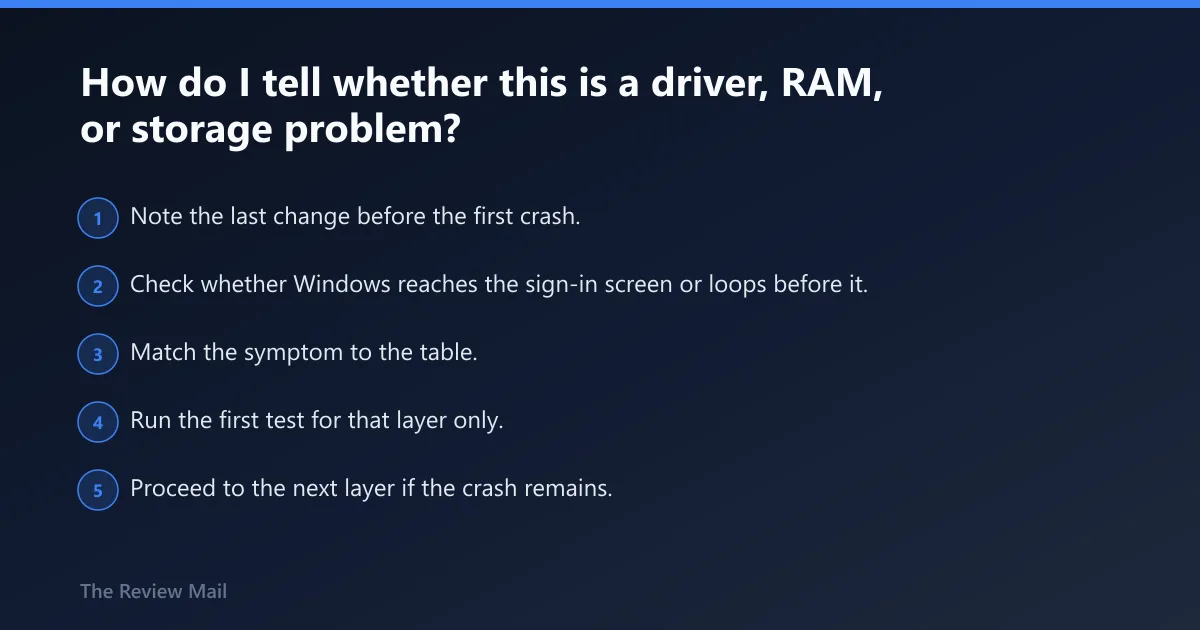
- Note the last change before the first crash.
- Check whether Windows reaches the sign-in screen or loops before it.
- Match the symptom to the table.
- Run the first test for that layer only.
- Proceed to the next layer if the crash remains.
Start with RAM checks before driver deep dives
Windows Memory Diagnostic is often a good first test when the cause is unclear, because bad RAM can corrupt driver data and make a healthy driver look guilty. If memory is healthy, you have better reason to spend time on drivers or the disk.
- Press Win + R, type mdsched.exe, and press Enter.
- Select Restart now and check for problems.
- Let the test finish after the reboot.
- Check the result in Event Viewer > Windows Logs > System if Windows does not show it directly.
- If errors appear, test each memory module separately or replace the failing stick.
If memory testing reports faults, stop chasing drivers first. Replace the bad module or run vendor diagnostics before any deeper software work.
Should I run CHKDSK or Memory Diagnostics first for this error?
Run Memory Diagnostic first when you do not yet know the source. Memory problems can corrupt the file system, so CHKDSK can show damage without telling you what caused it. Once RAM looks healthy, CHKDSK is the next sensible check for disk errors.
- Open Windows Memory Diagnostic and test RAM first.
- If RAM passes, open Command Prompt (Admin).
- Run
chkdskC: /f and allow the scheduled reboot if prompted. - If Windows still crashes, review the dump and the disk health result together.
- If
CHKDSKreports repeated errors, back up data and inspect the drive.
A clean CHKDSK result does not clear the disk forever; it only removes one likely layer. If crashes continue, the next target is usually a driver.
How do I isolate a bad driver or app?
Use Safe Mode to reduce loaded drivers, then Clean Boot to separate Microsoft services from third-party startup software. If the system stays stable there, uninstall the newest app first. Graphics drivers are common suspects, and Windows can reinstall one automatically after a restart.