CRITICAL_SERVICE_FAILED BSOD Fix Windows 11 Recovery
For CRITICAL_SERVICE_FAILED on Windows 11, start in WinRE: if keyboard or touchscreen works, try Startup Repair, Safe Mode, or uninstalling the most recent update; if WinRE input does not work, move to offline repair or data-first recovery. Leave it alone and a fixable boot loop can turn into lost files or a reinstall. This guide gives a step-by-step decision path for WinRE access, failed repair tools, and getting data out first when the desktop never loads.
What CRITICAL_SERVICE_FAILED means on Windows 11
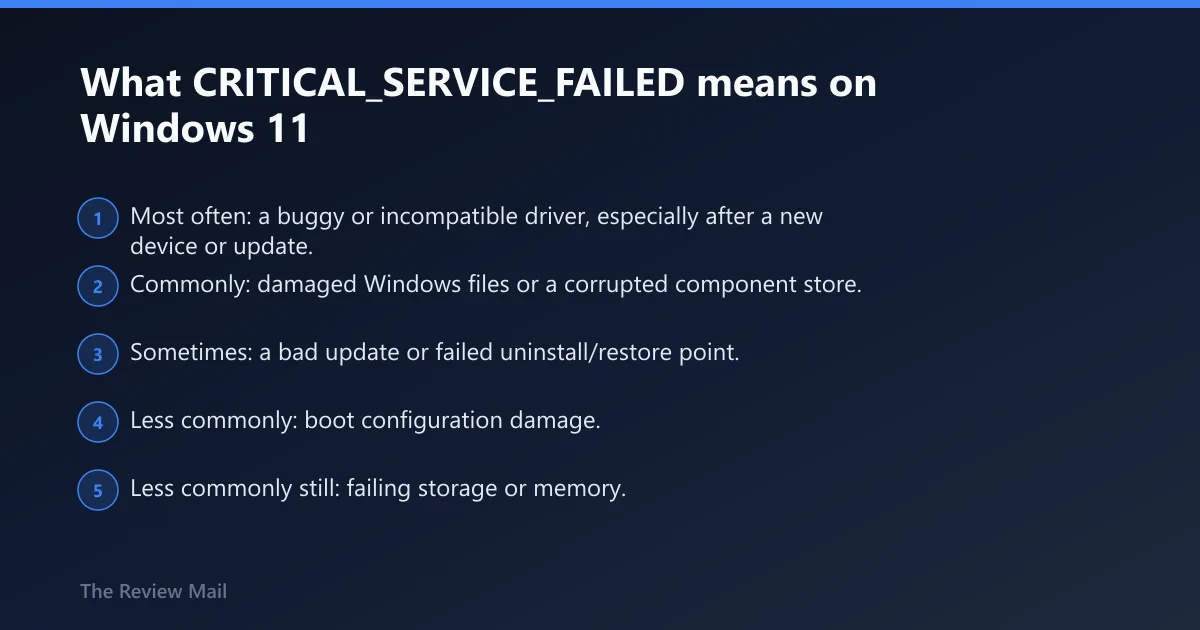
CRITICAL_SERVICE_FAILED is stop code 0x0000005A. It can trap the PC in a repeat boot loop. The usual triggers are a bad driver, damaged system files, a failed update, or boot corruption, and less commonly a storage or memory fault that keeps the same service from loading.
The fastest first move is to get into Windows Recovery Environment, then decide whether repairs can run from there. WinRE is the main repair entry point when the desktop will not load, and it can be reached from interrupted boots or a Windows USB installer media.
Likely causes, ranked by frequency
- Most often: a buggy or incompatible driver, especially after a new device or update.
- Commonly: damaged Windows files or a corrupted component store.
- Sometimes: a bad update or failed uninstall/restore point.
- Less commonly: boot configuration damage.
- Less commonly still: failing storage or memory.
According to How to Fix CRITICAL SERVICE FAILED BSOD in Windows 10/11 — CRITICAL_SERVICE_FAILED uses stop code 0x0000005A.
How should I triage the boot loop first?
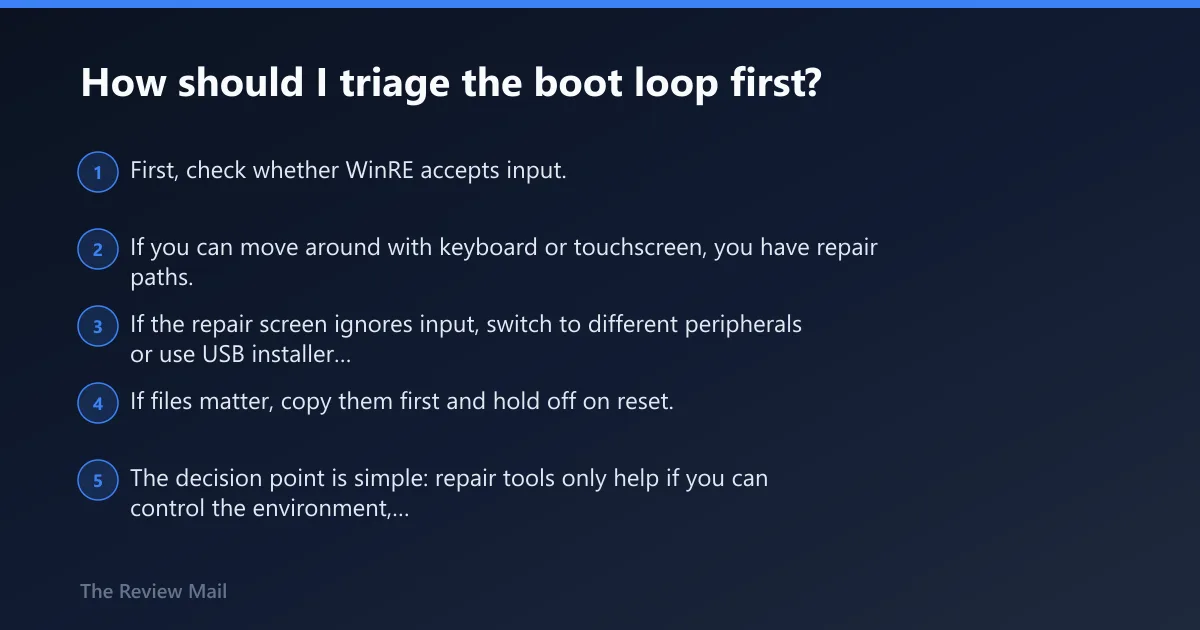
First, check whether WinRE accepts input. If you can move around with keyboard or touchscreen, you have repair paths. If the repair screen ignores input, switch to different peripherals or use USB installer media before trying deeper repairs. If files matter, copy them first and hold off on reset.
The decision point is simple: repair tools only help if you can control the environment, and a wipe only makes sense after data is safe. That order matters more than any single command.
Recovery decision table: choose the right path
| Real-world state | Exact next action | Expected result | Stop point |
|---|---|---|---|
| WinRE input works | Run Startup Repair, then Safe Mode or command prompt repair | Windows boots, or you get a narrower fault to fix | Stop after the first action that restores a stable boot |
| WinRE input fails | Use USB installer media, or switch to another keyboard and mouse | Repair menus become usable again | Stop once you can reach Troubleshoot |
| Data must be preserved | Copy files first, then repair or reset | Personal files are saved before destructive steps | Stop when the backup is complete |
Safe Mode entry:
Settings > Recovery > Advanced startup > Restart now > Troubleshoot > Advanced options > Startup Settings
Then press the number for Safe Mode or Safe Mode with Networking.

Offline repair commands from WinRE:
DISM /Image:C:\ /Cleanup-Image /RestoreHealth
sfc /scannow /offbootdir=C:\ /offwindir=C:\Windows

Boot repair:
bootrec /fixmbr
bootrec /fixboot
bootrec /scanos
bootrec /rebuildbcd
How do I fix it when WinRE works?
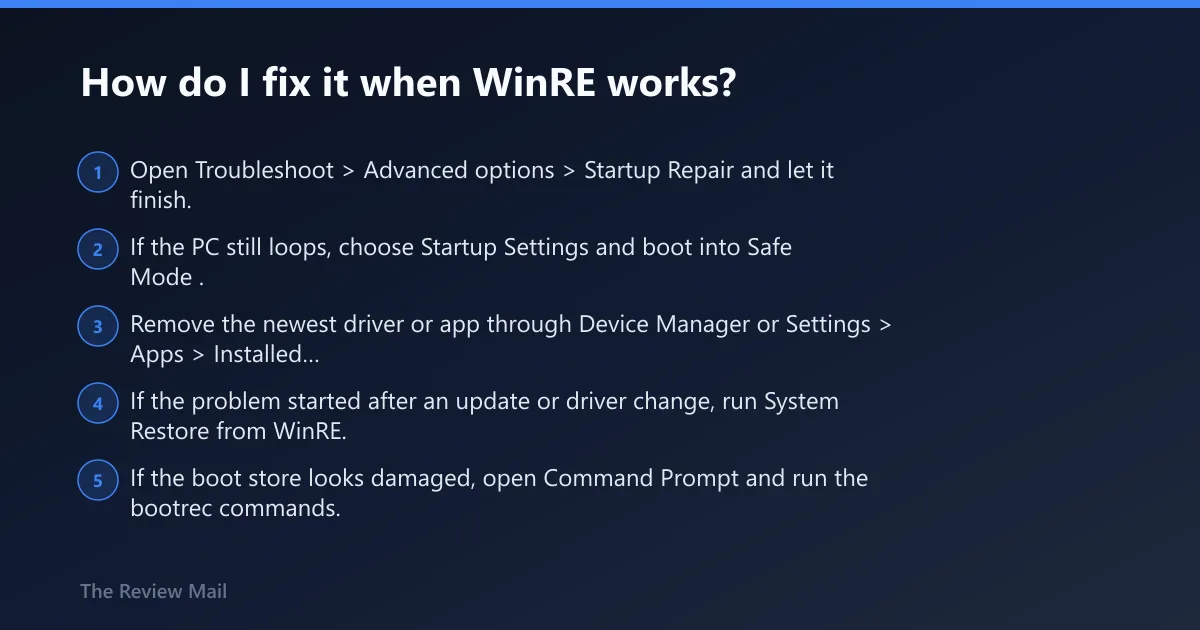
When WinRE responds, start with Startup Repair, the built-in automatic boot repair that often clears simple boot damage before anything else. If that fails, move to Safe Mode and remove the last driver, app, or update that changed the system.
If Windows can reach the desktop or at least partial startup, Safe Mode can usually be enabled from Startup Settings in WinRE, and the networking variant can be useful when you need downloads or logs. On a partially working system, msconfig can be used to boot into Safe Mode too (per Microsoft support).
- Open Troubleshoot > Advanced options > Startup Repair and let it finish.
- If the PC still loops, choose Startup Settings and boot into Safe Mode.
- Remove the newest driver or app through Device Manager or Settings > Apps > Installed apps.
- If the problem started after an update or driver change, run System Restore from WinRE.
- If the boot store looks damaged, open Command Prompt and run the bootrec commands.
Use bootrec /fixmbr, bootrec /fixboot, bootrec /scanos, and bootrec /rebuildbcd from the recovery command prompt when boot configuration damage looks likely. That is the right place for those commands, not a normal desktop shell.
Can DISM and SFC fix CRITICAL_SERVICE_FAILED?
Yes, sometimes. DISM and SFC are the standard file-repair pair, and they are used in that order because DISM can fix the Windows image that SFC depends on. If corruption is severe, SFC may fail even when DISM finishes cleanly (per Microsoft support).
Run them against the offline Windows installation from WinRE, not against the recovery environment. The Windows drive letter may differ in recovery, so use the letter assigned to the installed Windows partition.
- Open Command Prompt from WinRE.
- Run
DISM /Image:C:\ /Cleanup-Image /RestoreHealth, replacing C: with the Windows partition if needed. - After DISM completes, run
sfc /scannow/offbootdir=C:\ /offwindir=C:\Windows. - If SFC reports unrepaired files, repeat the command once after a reboot into Safe Mode.
- If both fail, move to bootrec or file recovery instead of looping the same pair.
If DISM succeeds but SFC still fails, the corruption is often deeper than file replacement can fix from the current install. At that point, boot configuration repair, Restore, or a backup-first reset becomes the better path.
How do I get into Safe Mode when Windows 11 keeps blue-screening?
Use WinRE Startup Settings if the machine can still reach recovery screens. Safe Mode is the best place to remove a bad driver or app because it loads a minimal set of services, and the networking variant gives access to logs or downloads when needed (per Microsoft support).
If Windows partially loads, msconfig can also force a Safe Mode boot. That works only when the desktop still opens far enough to change boot options.
- Go to Troubleshoot > Advanced options > Startup Settings.
- Select Restart.
- Press 4 for Safe Mode, or 5 for Safe Mode with Networking.
- In Safe Mode, open Device Manager and roll back or uninstall the newest device driver.
- If needed, open msconfig and clear the Safe boot setting after testing.
What should I do if Automatic Repair keyboard and mouse stop working?
When keyboard and mouse stop responding on the blue repair screen, the problem is not just Windows corruption; it may be a USB path, HID driver, or firmware issue. Start by moving the devices to rear USB ports, then test a basic wired keyboard and mouse before trying more advanced fixes.
If input still fails, use USB installer media to enter WinRE, because that bypasses the broken local recovery path. This edge case needs a different route, not repeated reboots.
- Unplug all non-essential USB devices.
- Connect a wired keyboard and mouse directly to rear ports.
- If input still fails, boot from USB installer media.
- On the installer screen, choose Repair your computer.
- From there, run Startup Repair or open Command Prompt for offline repair.
How do I recover files before wiping a Windows 11 drive?
Copy files out first if the data matters. WinRE and USB installer media can both be used to reach a command prompt or file browser path for backup, and a second PC with an external drive is the safest destination. Do not start a reset until the backup is complete.
After the files are safe, you can return to the crash analysis. Minidumps are still useful later, but they are not more important than the files on the drive.
- Attach an external drive to the troubled PC, or remove the drive and connect it to a second PC.
- Use WinRE Command Prompt or another recovery environment to copy C:\Users\ folders to the backup drive.
- Save Desktop, Documents, Pictures, Downloads, and any app-specific data you need before resetting or clean installing.
- Only after backup is complete, decide between Reset This PC and clean install.
What if Startup Repair, System Restore, and updates removal all fail?
That usually means the crash is below the easy repair layer, so the next move is diagnosis and containment. Check C:\Windows\Minidump\ for the dump files, open them in WinDbg Preview, and look for the driver or service named in the crash. Ritridata notes that minidumps can reveal the exact driver name, which is often the fastest clue.
If the same stop code returns after those repairs, test storage and memory before wiping anything. Microsoft’s !analyze debug extension can also help identify the root cause from the dump (per Microsoft support).
- Open
C:\Windows\Minidump\and copy the newest .dmp file. - Load it in WinDbg Preview and run !analyze.
- Uninstall or roll back the driver that appears in the crash output.
- Run Windows Memory Diagnostic or memtest86.
- Run
chkdskif disk corruption or bad sectors are suspected.
Prevention: after recovery, keep the newest driver and update changes documented so a second crash points faster to the last change.
How do I fix CRITICAL_SERVICE_FAILED on Windows 11?
Start in WinRE, run Startup Repair, then move to Safe Mode if the machine can boot far enough to remove the newest driver, app, or update. If those paths fail, use DISM, then SFC, and only then move to bootrec or a backup-first reset. The order matters.
What causes stop code 0x0000005A in Windows 11?
It is usually tied to a bad driver, damaged system files, a failed update, or boot corruption. Less often, storage or memory problems keep the same service from starting cleanly. The quickest way to narrow it is a minidump review plus a check of whatever changed last.
Can a bad Windows update cause CRITICAL_SERVICE_FAILED?
Yes. A bad update can trigger the loop, and System Restore may help if the restore point is intact. If the restore attempt returns an error such as 0x80070003, move on to Safe Mode, update removal, or boot repair instead of retrying the same restore point.
Is CRITICAL_SERVICE_FAILED usually a driver problem or hardware problem?
It is more often a driver, file, or update problem than a dead component. Hardware still needs a check if the same stop code returns after repair, especially storage and RAM. Minidumps help separate those cases because they often name the failing driver or service.