Device Manager Windows 11 CMD: Open It Fast in Seconds
In Windows 11, open Command Prompt, type devmgmt.msc, then press Enter. That opens Device Manager, the built-in Windows hardware console for viewing attached devices and managing drivers, enable or disable actions, and device properties. The same command may also work on Windows 10 and some Server editions.
This guide is part of our Windows driver errors: full list and fixes series.
How do you open Device Manager from CMD in Windows 11?
Open the console, then launch Device Manager
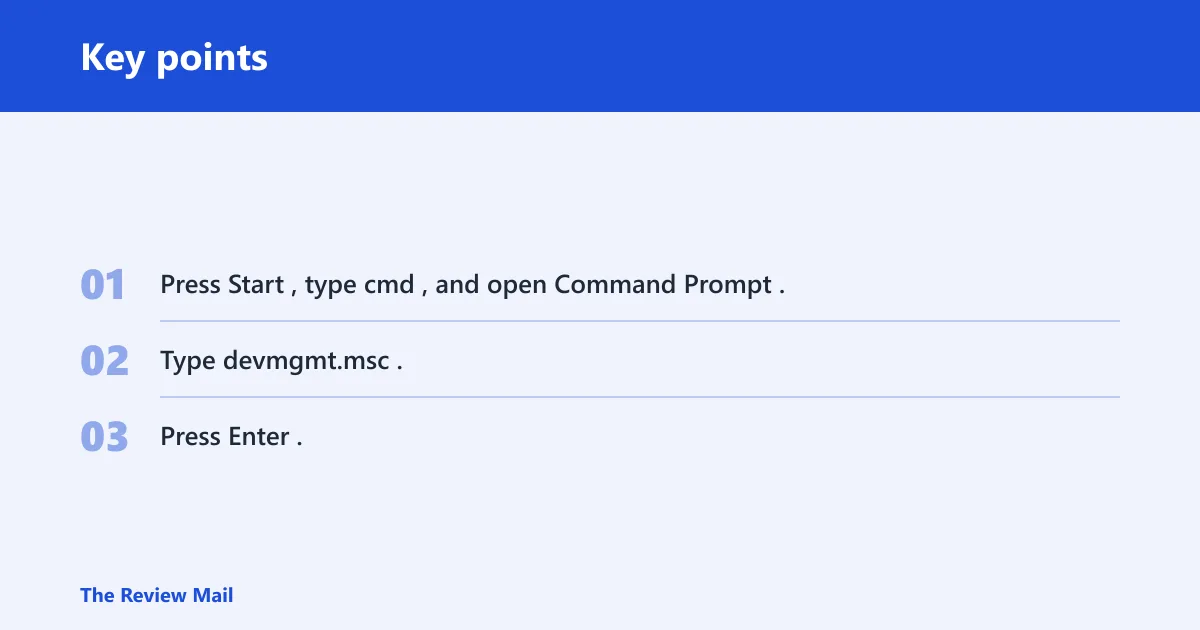
- Press Start, type cmd, and open Command Prompt.
- Type
devmgmt.msc. - Press Enter.
That is the direct path. You do not need another utility or a Control Panel search. The command runs the Device Manager MMC console file, so it opens the familiar tree of hardware categories, not a separate program with a different interface.
Use an administrator Command Prompt when you need elevated changes
Opening Device Manager does not always require administrator rights. Some actions inside it do. If you plan to disable hardware, roll back a driver, or change settings that trigger elevation, start Command Prompt as administrator first. The console may open either way, but elevated tasks are more likely to proceed cleanly from an elevated shell.
Picture a laptop with a network adapter showing a warning icon after a bad driver update. Launching Device Manager is quick. Actually disabling and re-enabling the adapter, or removing a driver package, is where admin status can matter. Keep the difference clear: opening the console is one task, changing devices is another.
What the command opens and what it does not change
devmgmt.msc opens Device Manager only. It does not fix the device, update the driver, or reset hardware by itself. That matters in driver-error troubleshooting, where speed helps, but the next step still depends on what the device list shows.
📊 Microsoft’s support page is labeled for Windows 10. Source: Open Device Manager.
What is the quickest Windows 11 shortcut if you do not want CMD?
If you want speed without opening Command Prompt, Windows+R and devmgmt.msc is the quickest direct route for many users. If you prefer a menu path, Win+X can expose a Device Manager entry. Windows 11 Search is fine when the shell is behaving normally, but it is not the quickest option.
Use the Run dialog with Windows+R
Press Windows+R to open the Run box, type devmgmt.msc, and press Enter. MiniTool also lists hdwwiz.cpl as an alternative command, and that can help when you are moving between Windows hardware tools. Run is a strong keyboard-only fallback because it avoids shell navigation entirely.
A common first-timer mistake is typing the command into a blank Start search field and waiting for Search to finish before pressing Enter. Run is quicker because it expects a command immediately. If you already know the file name, it removes the extra step.
Try Win+X for the Device Manager entry
Right-clicking Start, or pressing Win+X, can show a Device Manager entry. That menu is often called the Power User menu. It is a good mouse-free shortcut when you want a pointer-friendly route but do not want to type the command.
Use Windows 11 Search when the shell is working normally
Microsoft says to select Start and enter device manager. That route is easy to remember and works well when Search is responsive. It is slower than Run or CMD, though, because it adds search indexing and result selection to the process. (Microsoft Support)
Does devmgmt.msc work from PowerShell too?
Yes. You can run devmgmt.msc in PowerShell and it opens Device Manager the same way it does in Command Prompt or Run. Use PowerShell only if it is already open or easier to reach than CMD. The command targets the MMC console file, not a shell-specific function.
Run the same command in PowerShell
Open PowerShell, type devmgmt.msc, and press Enter. The command works on Windows 11 and Windows 10, and Microsoft’s support material also places it in the same launch category as other shell-based routes. The shell changes, but the console file stays the same.
Why the command works across shells
devmgmt.msc is a Microsoft Management Console file. CMD, Run, and PowerShell can all hand that file to Windows for opening. That is why the launch path is consistent even though the shells look different. The command is the same; only the entry point changes.
Which path should you use if the shell or Search is failing?
If CMD, Run, or Search is broken, move around the shell instead of waiting on it. Open Device Manager through Windows Tools or Computer Management, use System Properties on the Hardware tab, or try hdwwiz.cpl as a fallback command. These routes keep you inside Windows even when the usual launch path misbehaves.
Open it through Windows Tools or Computer Management
MiniTool notes that Device Manager can be found in Windows Tools. It also appears through Computer Management, where it sits in the left pane. Those paths are slower than typing the command, but they help when the shell is unreliable or the Start menu search is not responding.
Use System Properties and the Hardware tab
MiniTool also mentions sysdm.cpl for System Properties. Open it, go to the Hardware tab, and use the Device Manager button. This is useful when a support workflow already points you toward system settings and you want a built-in route instead of a command window.
Use hdwwiz.cpl when a hardware wizard route is enough
hdwwiz.cpl is another command in the same family. It does not replace Device Manager, but it gives you another built-in path when you are dealing with hardware setup or recovery tasks and one launch route is blocked. Keep it as a backup, not your first choice.
How to get to Device Manager Windows 10
The command is the same on Windows 10: devmgmt.msc. Open CMD, Run, or PowerShell and launch it from there. Windows 11 is the priority here, but Windows 10 still follows the same command path, which matters if you are supporting older machines or moving between versions.
Use the same launch logic
Start Command Prompt, type devmgmt.msc, and press Enter. If you prefer a shortcut, Windows+R works the same way. Microsoft’s support page is labeled for Windows 10, but the command itself also works on Windows 11 and Server editions.
Decision table: CMD, Run, PowerShell, Win+X, or Search
Use this one-page comparison to pick the best route for your situation. The right choice depends on whether you already have a shell open, whether you need admin privileges for device work, and how much you want to avoid the mouse.
| Path | Speed | Admin need | Keyboard-only fit | Best use case |
|---|---|---|---|---|
CMD + devmgmt.msc | Fast | Only for elevated device changes | Strong | Quick command-line launch and troubleshooting |
Run + devmgmt.msc | Very fast | Usually no for opening; yes for some device work | Very strong | Quick direct launch for most users |
PowerShell + devmgmt.msc | Fast | Only for elevated device changes | Strong | When PowerShell is already open |
| Win+X | Fast | No for opening | Strong | Mouse-free menu access to the Device Manager entry |
| Search | Moderate | No for opening; varies for follow-up actions | Moderate | Mouse-first fallback when the shell is fine |
For pure speed, Run is usually the best option. For command-line troubleshooting, CMD is the clearest choice. For a broken shell, use Windows Tools, Computer Management, or System Properties instead of waiting on Search.
What should you check if devmgmt.msc does not launch?
If devmgmt.msc does not launch, first check spelling, spacing, and the shell you are using. The command should be typed exactly. If that is correct, try another route such as Run, PowerShell, or Win+X. If the shell host is not responding, switch to a navigation path inside Windows.
Check spelling and spacing
The most common failure is a typo. devmgmt.msc must be entered as a single command with no extra spaces. If you mistype it as dev manager or add punctuation, Windows will not know what to open. Re-enter it carefully before assuming the system is broken.
Confirm that the MMC file path is being run correctly
The command launches an MMC console file. If you paste it into the wrong place or into a field that expects search terms, the result can be confusing. Use CMD, Run, or PowerShell for the command path. If one shell is stuck, another one may still work.
Try another launch route if the console host is not responding
When Search or the shell is frozen, switch to Win+X, Windows Tools, or Computer Management. Those paths bypass the failing launch point. If you need a quick hardware check, that saves time compared with waiting on a search pane or a sluggish terminal window.
Frequently asked questions
How to open Device Manager Windows 11 CMD?
Open Command Prompt, type devmgmt.msc, and press Enter. That command opens Device Manager on Windows 11. If you plan to change device settings that require elevation, open Command Prompt as administrator first. The console itself opens without admin rights, but some actions inside it may not.
What command opens Device Manager in Command Prompt?
The command is devmgmt.msc. Type it in Command Prompt and press Enter. It launches the Device Manager MMC console, which lists attached hardware and provides access to driver, enable, disable, and properties actions. It is the direct command-line answer for Windows hardware management.
Does devmgmt.msc work on Windows 11?
Yes. devmgmt.msc works on Windows 11. It also works on Windows 10 and Server editions. You can run it from Command Prompt, Run, or PowerShell. Microsoft’s support guidance and third-party Windows 11 guides both treat it as a valid launch method.
Can I run Device Manager from PowerShell?
Yes. PowerShell can run devmgmt.msc the same way CMD can. That is useful when PowerShell is already open or easier to reach than Command Prompt. The command opens Device Manager directly, so the shell you start from does not change the result.
What is the quickest way to open Device Manager in Windows 11?
For most users, Windows+R followed by devmgmt.msc is the quickest direct route. If you already have Command Prompt open, typing the same command there is just as efficient. Win+X is a strong no-typing fallback, and Search is better suited to slower, mouse-first access.
Why is devmgmt.msc not working in CMD?
Usually the command is misspelled, entered in the wrong place, or blocked by a shell problem. Check the exact spelling, then try Run or PowerShell. If the shell itself is unstable, use Win+X, Windows Tools, or Computer Management to reach Device Manager without relying on the same command path.