Problem Driver Pointer System: What a PDPS Hit Means
If your notice says PDPS found an issue, treat it as a licensing and record-check problem first. The Problem Driver Pointer System points the inquiring jurisdiction to the State of Record, where the driver history sits. A hit is a pointer result, not a final legal ruling, so verify the source record with the correct state office afterward. NHTSA describes the National Driver Register as the federal index of problem-driver information, and 23 CFR Part 1327 governs how participating jurisdictions exchange and use that information.
Related help: NDR record checks, license reinstatement, out-of-state suspension clearance, DMV renewal holds.
What is PDPS?
Problem Driver Pointer System, or PDPS, is a national pointer system used by state and local jurisdictions to search National Driver Register data and identify the State of Record. NHTSA says the NDR contains information on problem drivers, and 23 CFR Part 1327 sets the federal rules for participation, disclosure, and use. PDPS does not replace the underlying file; it points the user to the state that holds it. (Nhtsa)
What a PDPS search is looking
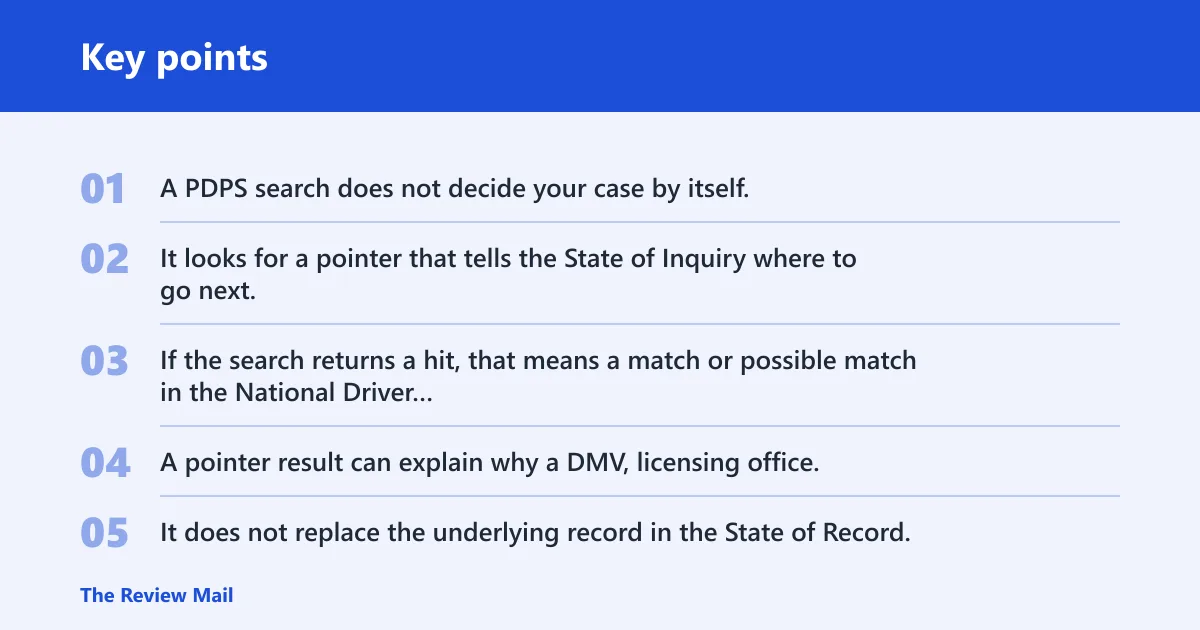
A PDPS search does not decide your case by itself. It looks for a pointer that tells the State of Inquiry where to go next, usually to the State of Record that keeps the driver status and history. If the search returns a hit, that means a match or possible match in the National Driver Register, not a final eligibility decision.
What a pointer result does and does not mean
A pointer result can explain why a DMV, licensing office, or court asks for more documents before renewal or reinstatement. It does not replace the underlying record in the State of Record. If you need the reason for the action, check the source file for the status decision, dates, and any conditions tied to clearance.
Is PDPS a real government database?
PDPS is part of a government record-check process, and its search results are tied to the National Driver Register, which NHTSA maintains under the U.S. Department of Transportation. Under 23 CFR Part 1327, participating jurisdictions may receive and use NDR information for licensing and related determinations. The system is used by participating jurisdictions nationwide, so a hit can affect licensing decisions across state lines.
How NDR feeds PDPS
The National Driver Register is the federal repository of problem driver information. PDPS uses that repository to route a search result back to the State of Record. That is why a state office may tell you to contact another state: the issuing office is the State of Inquiry, while the record that matters sits with the state that entered it.
Why jurisdictions use the system
Jurisdictions use PDPS to avoid issuing or renewing a license when another state already holds a disqualifying record. That matters for interstate consistency. It also keeps the process tied to a source record, rather than to a generic notice that leaves you guessing which state must clear the issue.
How PDPS works
PDPS works as a pointer system, not a stand-alone case file. The State of Inquiry submits a search, PDPS checks the NDR, and the result points back to the State of Record if there is a match. AAMVA’s PDPS system page is the operational reference for system notices, documentation, and cleanfile guidance, including quarterly refresh procedures and file-submission formats.
State of Inquiry versus state of Record
The State of Inquiry is the issuing state or jurisdiction making the search. The State of Record is the state where the driver status or history is stored, and it is the destination pointed to by PDPS. That split matters because the office that found the issue may not be the office that can fix it.
What the pointer sends back
PDPS returns a pointer, not the whole underlying file. In practice, that means the result identifies where the source record sits and signals whether the record includes a problem-driver condition. The hit can include a revoked, suspended, canceled, denied, or serious traffic offense record reference in the NDR file.
Official rules and refreshes
23 CFR Part 1327 governs participation in NDR/PDPS and the exchange of information for licensing purposes, including the duties of participating jurisdictions and the handling of records. AAMVA’s PDPS system page is the official operational reference for documentation links, scheduled maintenance, and cleanfile guidance. A cleanfile is an optional quarterly refresh process that replaces all pointers on the PDPS file and requires SFTP or FTPS submission.
PDPS triage matrix
Use this table to match the notice pattern to the next action. It keeps you from calling the wrong office first, which is the most common delay when a PDPS issue is described only as “there’s a problem on the record.”
| Symptom pattern | Likely cause | Next best action |
|---|---|---|
| Cannot renew or get a license until the issue clears | PDPS hit pointing to a State of Record with an unresolved status | Contact the State of Record first and ask what exact record entry is blocking eligibility |
| Intermittent holds after a recent court or administrative action | Record update has not fully synced or the source status is still active | Ask the State of Record whether the action was entered, closed, or still pending |
| Issue appears only on an out-of-state renewal or transfer | Cross-state PDPS search is finding a prior record that the current state does not control | Have the State of Inquiry identify the pointer result and then verify the source with the State of Record |
| Notice arrives after a DMV or state process update | New processing rules, maintenance, or a fresh PDPS inquiry surfaced an older record | Check the notice details, then compare them with the current State of Record entry and any pending paperwork |
| Conflicting notices from different offices | One office has the pointer result while another holds the underlying record | Use the State of Record as the source of truth and keep the State of Inquiry informed with that case number |
How do I check my PDPS status?
You usually check PDPS status through a DMV or licensing office, not through a public self-lookup. Ask the State of Inquiry whether a PDPS search returned a pointer, which state was identified as the State of Record, and whether the notice is a hold, a request for documents, or an outright denial. Then confirm the source record with the State of Record.
What to ask the State of inquiry
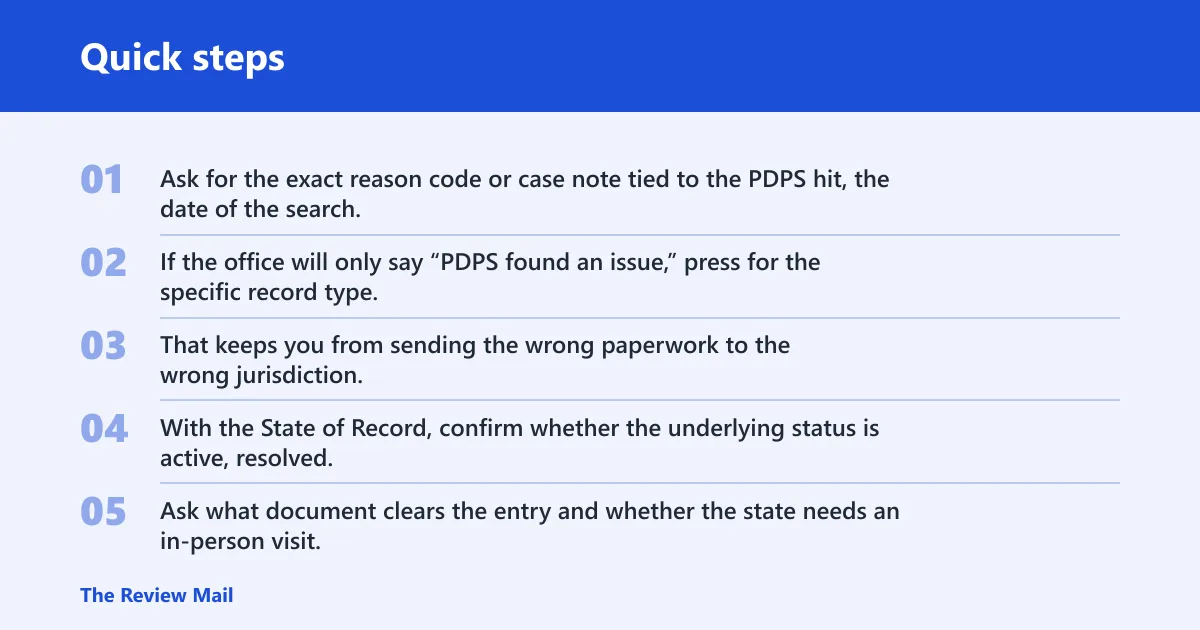
Ask for the exact reason code or case note tied to the PDPS hit, the date of the search, and the identity of the State of Record. If the office will only say “PDPS found an issue,” press for the specific record type. That keeps you from sending the wrong paperwork to the wrong jurisdiction.
What to confirm with the State of Record
With the State of Record, confirm whether the underlying status is active, resolved, or waiting on a step such as reinstatement paperwork. Ask what document clears the entry and whether the state needs an in-person visit, mailed forms, or proof from a court or another agency. Common requests include clearance letters, proof of completion, fee receipts, court abstracts, release forms, or reinstatement orders. The source state controls the eligibility decision.
Say your renewal is blocked after an out-of-state suspension shows up in PDPS. The fastest path is not a generic DMV counter visit. Call or visit the State of Record to confirm the exact status, then return to the State of Inquiry with proof that the source entry was cleared. Most states update a source record after they receive the required court, compliance, or reinstatement proof, but processing time varies by office and by whether the source is awaiting manual review.
Which states participate in PDPS?
Participation matters because the system only works if jurisdictions exchange search results and source records. NHTSA and AAMVA describe PDPS as a nationwide driver-record pointer process used by participating jurisdictions; however, the current operational status can change by transaction type and maintenance window. Check the official AAMVA PDPS system page or NHTSA PDPS-related information for the current list and related guidance.
How to verify current participation
Use the official systems page first, since it is the place that points to documentation and maintenance notices. If your issue involves a specific jurisdiction, confirm whether that state is participating for the transaction you need, and whether a cleanfile or other scheduled update may affect the timing of the search result.
Why participation matters for licensing decisions
If a jurisdiction participates, it can receive PDPS pointer results and use them in licensing decisions. That is why a move, renewal, or reinstatement can get delayed by an out-of-state record. The real key is not whether a state is “in PDPS” in the abstract, but whether the search pulled back a valid pointer for your case.
Picture a driver who moved from one state to another and tries to renew with a clean local record. If the prior state still holds a suspension entry, the new state’s inquiry can return a pointer to that State of Record. The local counter may be the place that issued the notice, but the fix still starts with the source state.
How do you resolve a PDPS issue on your record?
Start with the State of Record, because that office controls the underlying eligibility decision. Gather the notice, your current license number, any court or compliance papers, and the dates on the PDPS hit before you call or visit. If the issue is a suspension, denial, cancellation, or serious offense entry, the source state can tell you what clears it.
Problem driver pointer system checklist
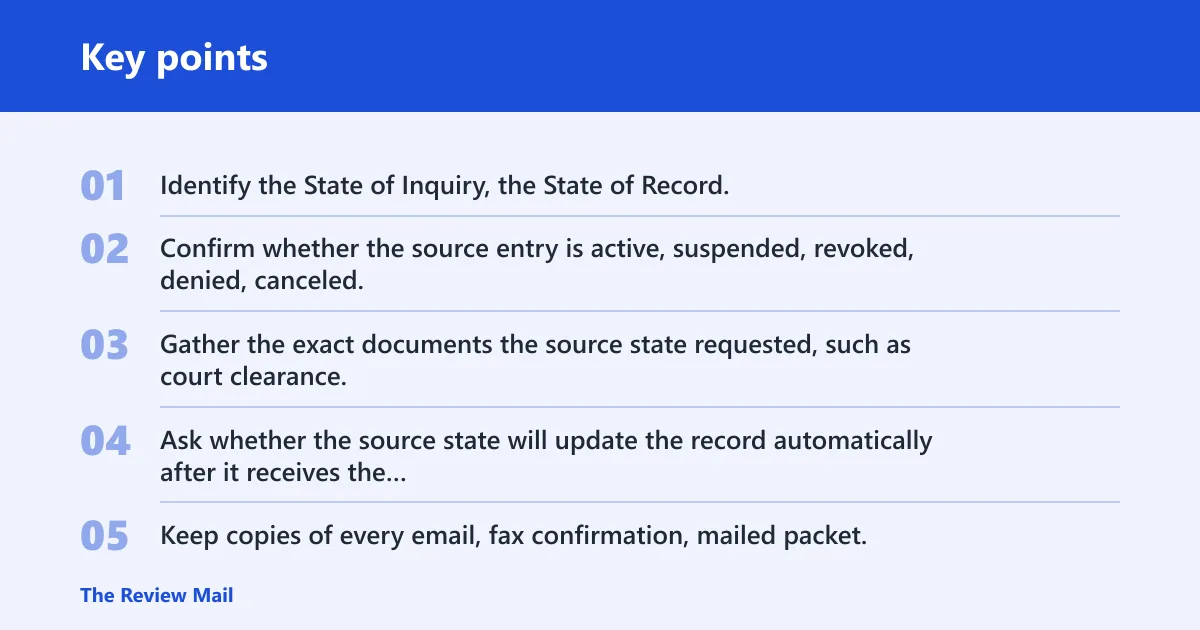
- Identify the State of Inquiry, the State of Record, and any case or reference number on the notice.
- Confirm whether the source entry is active, suspended, revoked, denied, canceled, or pending correction.
- Gather the exact documents the source state requested, such as court clearance, completion proof, payment receipts, or reinstatement forms.
- Ask whether the source state will update the record automatically after it receives the documents or whether a follow-up submission is required.
- Keep copies of every email, fax confirmation, mailed packet, and receipt until the State of Inquiry confirms the hold is removed.
- Recheck the record only after the source state says the action has been posted or cleared.
Renewal versus transfer versus reinstatement decision tree
The right path depends on what the notice is blocking. Renewal usually means the current state needs an updated clearance; transfer usually means the new state is waiting on a source-state pointer; reinstatement usually means the state that imposed the action needs compliance documents before it updates the record.
- If you are renewing: ask the State of Inquiry what exact item is holding the renewal and whether the source state must send a release first.
- If you are transferring from another state: contact the State of Record first, then have the new state recheck after the source record is corrected.
- If you are reinstating: complete the source-state requirements first, then confirm the record update before returning to the issuing office.
Sample script and email for contacting the State of Inquiry and State of Record
Use a direct, document-focused message so the office can locate the file quickly. Keep the request centered on the record entry, the date of the pointer, and the exact clearance needed.
- Phone script for the State of Inquiry: “I received a notice that a PDPS search found an issue. Please give me the date of the inquiry, the State of Record, and the exact reason my application is on hold so I can send the correct documents.”
- Phone script for the State of Record: “Please confirm the current status on my driving record, what document clears the entry, and whether you need the paperwork mailed, uploaded, or submitted in person.”
- Email template: “Subject: PDPS/NDR record inquiry and clearance request. Please confirm the status tied to my record, the exact documents required for clearance, and the estimated processing time once those documents are received. I can provide the notice, license number, case number, and supporting paperwork.”
When a renewal, suspension, or hold needs follow-up
If the notice blocks renewal, do not assume one office can clear it alone. A PDPS hit can stop issuance or renewal until the State of Record says the matter is resolved. If the notice involves a suspension or hold, ask whether the source state needs proof of payment, completion, or a formal release before the record is updated. Typical turnaround ranges from immediate posting after electronic receipt to several business days or longer when the file requires manual review.
What documents to gather before you call or visit
Bring the letter or email that mentions PDPS, your license or ID, and anything the notice references by date or case number. If another state is involved, bring those records too. That gives the State of Record enough detail to locate the exact entry instead of guessing from a name match alone.
Frequently asked questions
What is the problem driver pointer system?
PDPS is a national driver pointer system that lets jurisdictions search NDR data and find the State of Record. It does not replace the underlying driver file. A pointer result tells an office where to check next for revoked, suspended, canceled, denied, or serious traffic offense records.
Is Problem Driver Pointer System a real government database?
Yes. It is a real government record-check process tied to the National Driver Register, which NHTSA maintains under DOT. PDPS uses that federal repository to return search results to participating jurisdictions, so the result can affect licensing decisions even though the source file remains with the State of Record.
Why did my DMV say PDPS found an issue?
That usually means the State of Inquiry received a pointer to a record that needs review before it can issue or renew a license. The issue may be an active suspension, a prior denial, or another problem-driver entry. The DMV is pointing you to the source state, not making a final finding by itself.
Does a PDPS hit stop me from renewing my license?
It can. A PDPS hit may block renewal until the State of Record resolves the underlying status and the State of Inquiry updates its file. The exact result depends on the source record and the receiving jurisdiction’s rules, so the next step is to confirm the status with the state that holds it.
Who runs the problem Driver pointer system?
NHTSA maintains the National Driver Register under DOT and publishes PDPS-related information. AAMVA provides the operational PDPS system reference with documentation links, maintenance notices, and cleanfile guidance. Jurisdictions use the system, but the source record and the pointer result are managed through those official federal and interjurisdictional channels.