Thread_stuck_in_device_driver BSOD fix for Windows 11
If thread_stuck_in_device_driver BSOD on Windows 11 starts during gaming or video playback, test the current GPU driver first: if a clean rollback or DDU reinstall fixes it, the driver is at fault; if two driver changes do not, suspect hardware. Ignoring that split wastes time, invites more crashes, and can corrupt work or game installs. This guide shows how to separate GPU driver regression, OEM package conflicts, and true hardware instability on Windows 11.
This guide is part of our Windows BSOD stop codes: full list and fixes series.
What THREAD_STUCK_IN_DEVICE_DRIVER means on Windows 11
This bug check is a blue screen of death (BSOD) with stop code 0x000000EA. In plain language, a graphics-related driver thread is spinning and Windows gives up, often because the driver is waiting on the GPU or display hardware and never gets a clean response (per Microsoft support).
It usually shows up during gaming, video playback, installs, or any other high GPU load task. Before changing anything, note the stop code text, the display driver name if it appears, the time of the crash, and whether the failure repeated after the same activity.
That evidence matters because the next step changes depending on whether the crash began after a driver update, after Windows Update, or after a hardware change.
According to Fix the Thread Stuck in Device Driver error in Windows — It can happen on Windows 10 and Windows 11.
What usually causes this BSOD?
Most often, the cause is a bad or recent GPU driver regression. Next on the list is a conflicting OEM graphics package or a Windows Update driver that overwrote a better vendor package. Less commonly, the issue is hardware instability, power delivery trouble, or BIOS compatibility on an older system (per Microsoft support; reported by windowscentral.com).
Likely causes in order
| Likely cause | Typical symptom | Best first clue |
|---|---|---|
| GPU driver regression | Crash began right after a driver change | Same app or game triggers it again |
| OEM package conflict | Vendor utility keeps reinstalling a package | Event Viewer shows the same display driver |
| Windows Update reapplying driver | Rollback helps, then the crash returns after reboot | Optional updates contains a graphics driver |
| Hardware instability | Crashes persist across multiple drivers | Minidumps vary or point nowhere stable |
| BIOS compatibility issue | Older board, newer GPU, repeated display faults | OEM support site offers a newer BIOS |
Should you update or roll back the GPU driver?
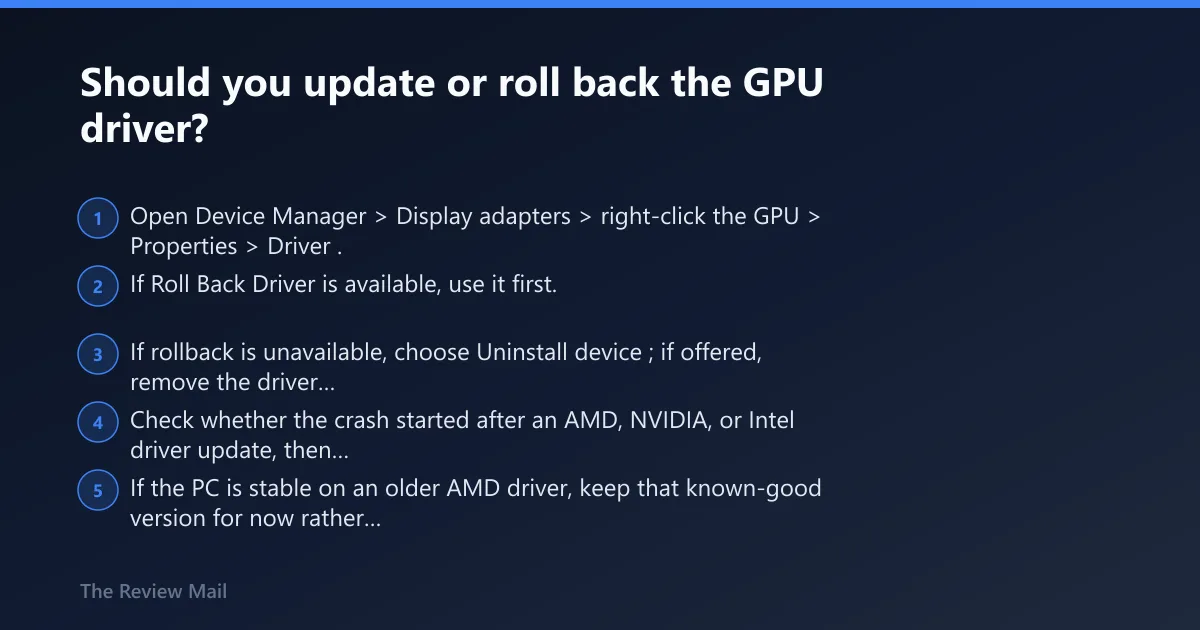
Roll back first if the crash started after a driver update. Update first only when the system is on an old driver and the crashes began after a Windows update or after moving to a new GPU stack. For AMD, NVIDIA, and Intel, the safest source is the hardware vendor or the PC maker’s support page, not a random driver pack.
- Open Device Manager > Display adapters > right-click the GPU > Properties > Driver.
- If Roll Back Driver is available, use it first.
- If rollback is unavailable, choose Uninstall device; if offered, remove the driver package too.
- Check whether the crash started after an AMD, NVIDIA, or Intel driver update, then install the matching OEM package or the vendor package for that exact GPU model.
- If the PC is stable on an older AMD driver, keep that known-good version for now rather than chasing the newest build.
If the system is an OEM laptop or desktop, the manufacturer’s package can be better than the generic vendor driver because it matches the firmware, power limits, and panel wiring that ship with that machine. That matters when one package works on a retail GPU but not on a laptop board.
How do you fix it in Safe Mode?
Safe Mode loads only the basic graphic driver, so it is the cleanest place to remove a broken display driver or reverse a bad update. It is also the recovery path when the PC boot-loops before the desktop appears (per Microsoft support).
- Go to Settings > System > Recovery > Advanced startup > Restart now.
- Choose Troubleshoot > Advanced options > Startup Settings > Restart.
- Press the key for Safe Mode.
- Open Device Manager > Display adapters > right-click the GPU > Uninstall device.
- If the box appears, select the option to delete the driver package, then reboot and test.
When the system comes back up, Windows should load the basic display driver without crashing. If it still BSODs in Safe Mode, the odds move away from a plain driver bug and toward a deeper hardware or firmware problem.
How do you stop Windows from reinstalling the bad driver?
Windows Update can hide driver updates in optional updates, so a “fixed” machine can break again after the next reboot or update pass. If an OEM utility is pushing the same package back, pause or remove that updater until the system stays stable (per Microsoft support).