Acpi asd0001 2 daba3ff 0 Windows 11
ACPI\ASD0001\2&DABA3FF&0 in Device Manager usually means Windows 11 has identified an OEM ACPI device, and the safest first step is to open Device Manager, check the Details tab for Hardware Ids and Compatible Ids, then use the support page for your exact PC model before you install anything else. A bad package can leave the device unknown, break hotkeys or power features, and waste time on updates that do nothing. This guide shows how to verify the hardware ID, decide whether Windows needs a chipset, BIOS, or vendor package, and avoid generic driver downloads.
What ACPI\ASD0001\2&DABA3FF&0 means
Windows is reporting an unknown ACPI device, not a normal plug-in peripheral. The string is a hardware ID in Windows hardware ID format, and the ACPI part points to the Advanced Configuration and Power Interface namespace that Windows uses to talk to firmware-managed components. The ending, 2&DABA3FF&0, is the device instance identifier that helps distinguish one installed entry in Device Manager from another.
Why Windows labels it as an unknown device
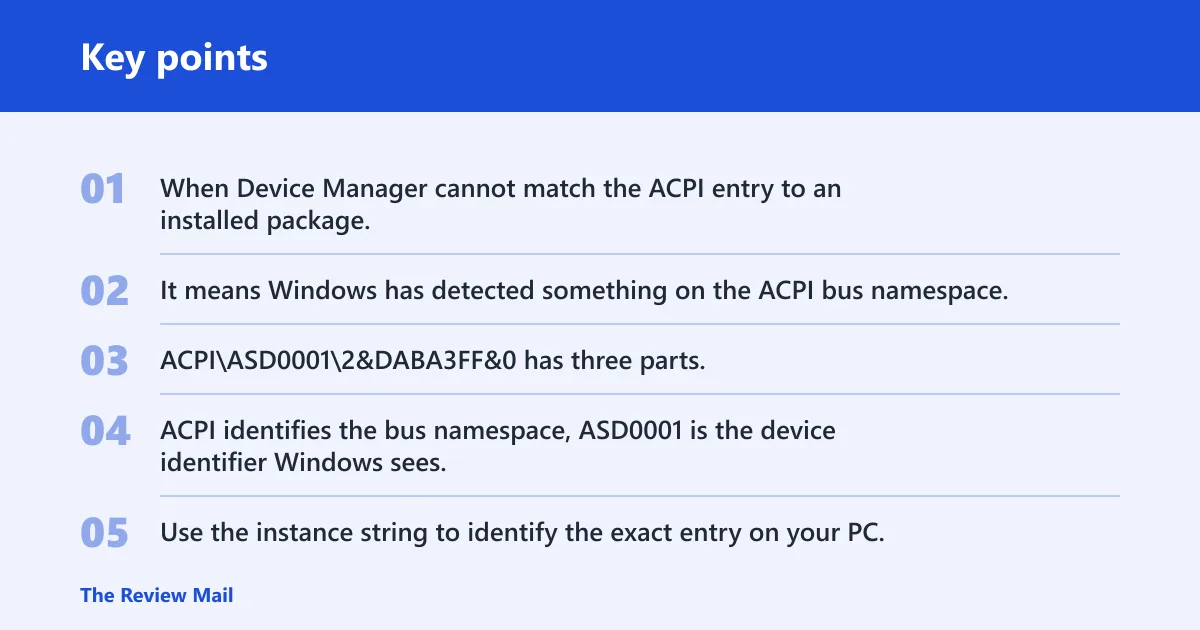
When Device Manager cannot match the ACPI entry to an installed package, it shows a generic unknown device label. That does not mean the hardware is bad. It means Windows has detected something on the ACPI bus namespace, but it still needs the correct platform driver, BIOS support, or vendor package to name it properly.
How to read the ACPI namespace and device instance identifier
ACPI\ASD0001\2&DABA3FF&0 has three parts. ACPI identifies the bus namespace, ASD0001 is the device identifier Windows sees, and 2&DABA3FF&0 is the instance string. Use the instance string to identify the exact entry on your PC, but rely on the Hardware Ids and Compatible Ids fields and the model support page when choosing a driver.
What the hardware ID does and does not prove
The ID can point to an OEM ACPI component, but it does not prove that you need a random generic driver. The more reliable next step is to compare the Hardware Ids and Compatible Ids in Device Manager with the downloads on your computer’s exact model or motherboard support page, because that is what determines the correct package.
Is this an AMD or Acer device?
It can be either a vendor-specific OEM ACPI device or a system package that appears through OEM servicing channels. The exact ID does not prove one brand by itself. You need to compare the PC model, the board vendor, the hardware IDs in Device Manager, and the package details before deciding whether the fix belongs to Acer/Gateway support, AMD system software, or a BIOS update.
Why Acer/Gateway appears in some driver listings
Use the OEM support page for the exact model, because vendor-specific ACPI devices are often documented there with chipset, firmware, or system utility downloads. If your PC model traces to Acer or Gateway, start there before searching broader driver libraries.
Where AMD system packages fit in the search
Microsoft Update Catalog can show system packages such as Advanced Micro Devices, Inc. – System – 1.2.0.46. The catalog shows that package as a Windows 10 Vibranium and later servicing driver and classifies it as Drivers (Other Hardware). That makes it a possible platform package, not proof that the device is a standalone AMD peripheral. (Microsoft)
How to compare 2&DABA3FF&0 with nearby IDs
Compare the Hardware Ids and Compatible Ids shown in Device Manager with the model page and any vendor package notes. If the same machine shows more than one ACPI entry, use the model and the matching IDs to decide which download applies.
Say your laptop shows ACPI\ASD0001\2&DABA3FF&0 and a second unknown ACPI entry. Treat the Device Manager details and the vendor page as the deciding factors, not the suffix alone.
ACPI device decision table
This table gives the safest next step for each check. Start at the top and stop as soon as one step clearly matches the device or a vendor page tells you the component is covered.
| Check | When it is appropriate | What to look for | When to stop |
|---|---|---|---|
| BIOS version check | When the unknown ACPI entry appears on a laptop or desktop with recent firmware changes, or when the vendor says the fix is in firmware | Current BIOS version in Windows 11, then the latest BIOS listed for your exact PC or motherboard model | Stop if the vendor notes mention ACPI, embedded controller, hotkey, power, or platform fixes and the update targets your exact model |
| OEM support lookup | When the machine is from Acer, Gateway, or another branded system maker | Chipset, motherboard, system utility, and firmware packages tied to the exact model | Stop if the support page lists a driver or BIOS update that names the board or system component behind the unknown device |
| Chipset package check | When Device Manager still shows the ACPI entry after Windows Update and vendor firmware checks | AMD or other chipset/system packages, including entries such as Advanced Micro Devices, Inc. – System – 1.2.0.46 | Stop if the package version matches the hardware family and Windows begins naming the device correctly after install |
| Microsoft Update Catalog verification | When the OEM page is unclear or the same hardware ID appears in a servicing driver listing | Exact hardware ID search, package name, version, date, and classification such as Windows 10 Vibranium and later | Stop if the package matches the exact hardware ID and vendor model; do not keep trying near-matches |
Check BIOS and motherboard support first
Firmware checks come first because the Microsoft answer describes these as BIOS or motherboard drivers. If the ACPI device is tied to platform firmware, no amount of random driver searching will help. Start with the current BIOS version, compare it with the vendor’s support page, and use the exact PC or board model name.
Find the current BIOS version in Windows 11
Open System Information and look for the BIOS Version/Date field, or check the firmware version shown in the UEFI setup screen. Write down the exact version string before you compare it with the vendor page. You need the exact model match, not a close family name.
Match the PC or board model on the vendor support page
Use the support page for the OEM, such as Acer or Gateway when the system points that way. If the BIOS page lists an update that mentions ACPI, embedded controller, power management, or system stability, that is the most relevant stop point. A motherboard vendor page can be just as important on a self-built machine.
When a BIOS update is the right stop point
If the support page shows a newer BIOS that is clearly linked to your exact model and the notes align with firmware or ACPI behavior, install that first. Do not treat every unknown ACPI item as a BIOS problem, though. If the BIOS version already matches the latest release, move on to chipset or servicing drivers.
Check chipset and system drivers next
Chipset and system packages are the next place to look after firmware. On some systems, Windows Update or the OEM package feed installs a servicing driver that fills in the missing ACPI name. That is where Advanced Micro Devices, Inc. – System – 1.2.0.46 can appear.
What advanced micro devices, inc. – system – 1.2.0.46 means
This package name is a specific servicing driver entry, not a broad answer for every ACPI device. Microsoft Update Catalog lists it as version 1.2.0.46, with a Windows 10 Vibranium and later servicing classification and a Drivers (Other Hardware) label. The catalog also shows package sizes that can vary across entries in this family, which is why size alone cannot confirm the right match.
Why package size alone is not enough
Small servicing drivers can still be correct, and larger ones can still miss the target. A 28 KB or 41 KB package may look too small to matter, but the important details are the exact device ID, version, classification, and vendor model. Size is a clue, not proof.
Suppose your system is an Acer notebook that still shows ACPI\ASD0001\2&DABA3FF&0 after BIOS updates. A chipset or system package from the OEM may fit better than a generic download, even if the catalog shows AMD in the package name.
Search microsoft Update Catalog safely
Microsoft Update Catalog can help, but only if you search by the device information from Device Manager and inspect the package details carefully. Use the Hardware Ids and Compatible Ids fields to narrow the result list to packages that match your exact model and platform.
Search by exact hardware ID
Search the hardware ID shown in Device Manager, then compare the result to the device in Device Manager and to the Compatible Ids field. If the catalog result matches the namespace but not the model or compatible IDs, treat it as a weak match.
Read the package name and version details
Check the package title, version, classification, date, and whether the listing mentions Windows 10 Vibranium and later servicing drivers. One catalog entry is dated 4/20/2020, which can help you sort older servicing packages from newer ones. If the package is for the wrong platform family, stop there.
When to stop if results do not match the device
If the catalog shows many near-identical results but none of them match your Hardware Ids, Compatible Ids, or model support page, do not guess. Go back to the OEM support page or BIOS notes. A mismatch is a sign to stop, not a reason to try more random downloads.
What to do if it stays unknown
If the ACPI entry remains unknown after Windows Update, BIOS checks, and chipset or vendor package review, do not force a third-party driver onto it. The device may need a model-specific OEM package, or it may be a platform component that Windows will only name after a later servicing update. Unknown does not mean broken.
Confirm Windows Update has run fully
Install all pending updates, restart, and check Device Manager again. Windows sometimes resolves ACPI entries only after a cumulative update and a second reboot. If the device still appears unknown, the next move is the OEM page, not a download site.
Recheck the OEM support page after BIOS and chipset updates
Vendors sometimes post the matching package under chipset, system utility, or motherboard support rather than under a device name. Search the PC model, then compare the notes for power management, hotkeys, and embedded controller items. Those hints often point to the correct ACPI fix.
When no driver is the correct answer yet
Some unknown ACPI devices stay unidentified because the needed package is not published for that model, or because Windows 11 has not pulled it yet. In that case, the safest action is to wait for the OEM or Windows servicing channel, not to install a random replacement.
Frequently asked questions
What is ACPI\ASD0001\2&DABA3FF&0?
It is an unknown ACPI hardware ID shown in Windows Device Manager. The ACPI part points to firmware-managed platform hardware, ASD0001 is the device identifier, and 2&DABA3FF&0 is the instance string. By itself, it does not tell you to install a generic peripheral driver.
Why does Windows 11 show ACPI ASD0001 2&DABA3FF&0 as unknown?
Windows 11 shows it as unknown when it sees the ACPI entry but does not yet have the correct OEM, chipset, or BIOS-backed package to name it. The fix usually starts with the PC maker’s support page, not with a random driver search, because the device often belongs to the platform firmware layer.
Is ACPI ASD0001 2&DABA3FF&0 an AMD or Acer device?
It can be linked to Acer or Gateway origin, and Microsoft Update Catalog also shows AMD system packages in the search results. That does not make it universally Acer or universally AMD. Use the exact model, the Hardware Ids and Compatible Ids, and the vendor support page to decide which family fits.
Do I need to download a driver for ACPI ASD0001 2&DABA3FF&0?
Usually you should not download anything until you check BIOS, OEM support, and chipset packages. Many ACPI entries resolve through platform software rather than a standalone driver. If a catalog listing matches the exact hardware ID and the vendor model, that is safer than a generic download.
Can Windows Update install the ACPI ASD0001 2&DABA3FF&0 driver automatically?
Yes, sometimes Windows Update installs the needed servicing driver automatically, especially for Windows 10 Vibranium and later packages. If it does not happen after all pending updates and a restart, move to BIOS and OEM support checks. Do not keep waiting on Windows alone if the device remains unknown.
Does ACPI ASD0001 2&DABA3FF&0 mean my PC is broken?
No. An unknown ACPI device usually means Windows has not matched the correct platform component yet. The hardware may still be functioning normally, including power and boot features. Treat it as an identification problem first, and only worry about hardware failure if other symptoms appear.