unexpected_kernel_mode_trap BSOD fix Windows 11 guide
For an unexpected_kernel_mode_trap BSOD fix on Windows 11, I start with minidumps and the last hardware or driver change. If memtest or a RAM swap reproduces the crash, I treat memory or BIOS settings first; otherwise I check chipset and storage drivers. Ignore that order, and you can burn hours replacing the wrong part while the PC keeps rebooting or corrupting files. This guide follows a cause-first triage flow for minidumps, recent changes, RAM, AMD chipset, firmware, and repair steps.
This guide is part of our Windows BSOD stop codes: full list and fixes series.
What Unexpected Kernel Mode Trap means on Windows 11
This stop error is a kernel crash, not a normal app fault. The UNEXPECTED_KERNEL_MODE_TRAP bug check has a value of 0x0000007F. It means the Intel CPU generated a trap and the kernel failed to catch this trap, which can happen with faulty memory, bad firmware, or a driver that corrupted kernel state.
On Windows 11, the screen may be black on version 24H2 rather than blue. That visual change does not alter the diagnosis. The useful clues are the stop code, whether the crash repeats at boot, and whether it appears only under load or right after a change.
What symptoms matter first
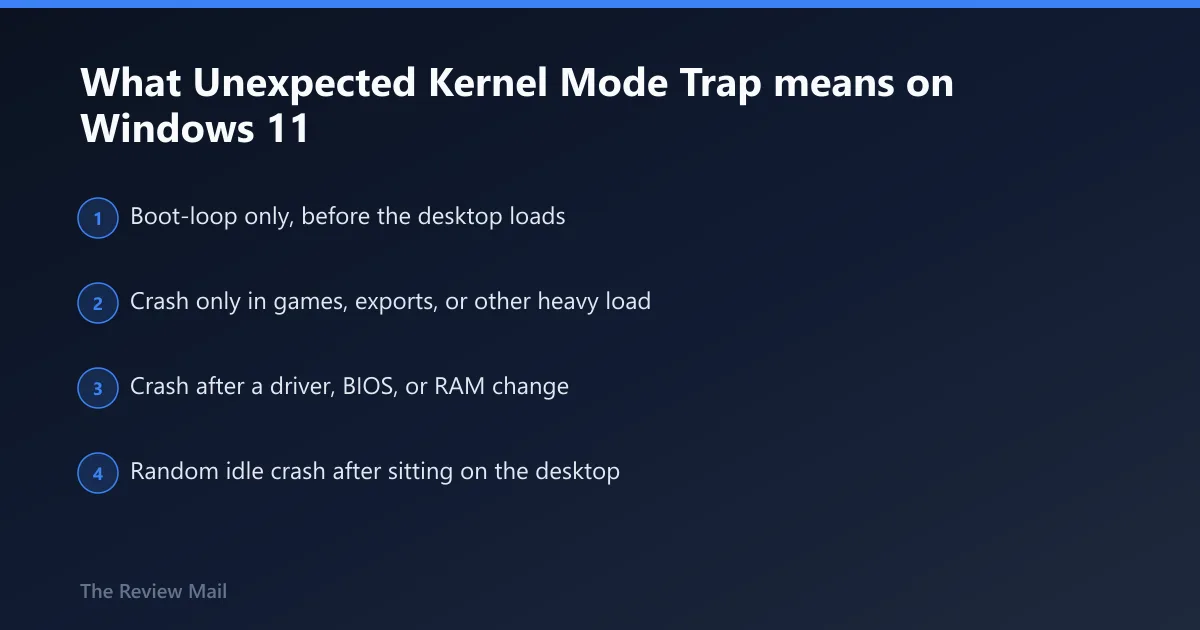
- Boot-loop only, before the desktop loads
- Crash only in games, exports, or other heavy load
- Crash after a driver, BIOS, or RAM change
- Random idle crash after sitting on the desktop
According to Blue screen of death – Wikipedia — Wikipedia states Windows 11 version 24H2 changed the BSOD background to black. (source)
Which cause is most likely?
Rank the likely causes by the symptom pattern. RAM comes first, then AMD chipset drivers on affected systems, then BIOS or firmware issues, then recent driver changes, then thermal stress or overclocking, and finally broader Windows corruption. The pattern usually points farther than guesswork does.
Record recent hardware swaps, BIOS updates, memory speed changes, and new software before changing anything else. A crash that starts after a RAM upgrade is a different branch from one that appears only after gaming or only after a BIOS flash.
Decision checklist by symptom pattern
| Symptom pattern | Most likely branch | Next best action |
|---|---|---|
| Boot-loop only | RAM, BIOS, or kernel driver | Enter Safe Mode and check minidumps, then test memory |
| Gaming or load-triggered | Thermal stress, RAM, or chipset | Check temperatures, remove any overclocking, update AMD chipset drivers |
| After driver update | Bad driver or rollback needed | Use Device Manager to roll back or uninstall the driver |
| After BIOS update | Firmware setting or compatibility issue | Load defaults, then re-check stability and minidumps |
| After RAM upgrade | Memory seating or faulty module | Reseat RAM and test one stick at a time |
| Random idle crashes | RAM, firmware, or Windows corruption | Read dumps, test memory, then repair Windows files |
How do I read minidumps for this BSOD?
Start in C:\Windows\Minidump. Those files can show whether the crash leans toward memory, chipset, or another driver fault, and the crash parameters help separate a bad module from a driver chain reaction. If the PC is unstable, copy the folder to a USB drive first.
If the system has several crashes, zip the minidumps before sharing them for review. That keeps the files together and preserves the exact set of recent failures. A single dump can mislead; a small batch often shows whether the same module or driver is involved each time.
- Open File Explorer and go to
C:\Windows\Minidump. - Copy the newest .dmp files to another location.
- Zip the files before upload or sharing.
- Note the stop code and the exact timing of each crash.
Fix RAM and memory stability first
RAM is the first hardware suspect because this stop error often traces back to memory problems. If the system changed after a RAM upgrade, a reseat or a one-stick test can separate a bad module from a bad slot or a memory profile that no longer holds under load.
Do this before a reset. A clean Windows install will not fix a failing stick, loose seating, or unstable memory timing. If crashes continue after memory checks, treat the module as suspect and test with known-good memory if available.
- Shut down, unplug power, and open the case.
- Reseat each RAM module fully.
- Boot with one stick at a time if there are multiple modules.
- Run Windows Memory Diagnostic or memtest86.
- Replace any module that fails or reproduces the crash.
Should I update AMD chipset drivers or BIOS?
Yes, if the system uses AMD and the crash started after a chipset, firmware, or stability change. Install the vendor-recommended AMD chipset driver version from the PC or motherboard support page, because the wrong package or an older generic version can keep the system unstable on Windows 11.